

Ship Parts Names Complete Guide to Ship Anatomy and Components
If you are looking for ship parts names, the easiest way to understand a vessel is to learn its major components from the bow and hull to the stern, deck, engine room, and navigation systems. Common ship parts include the bow, stern, hull, keel, deck, bridge, mast, propeller, rudder, anchor, and engine.
Whether you are a student, boating enthusiast, maritime professional, or simply curious about how ships work, knowing these terms makes ship diagrams and nautical terminology much easier to understand. Different vesselsfrom cargo ships and cruise ships to fishing boats and military vesselsuse different equipment, but many fundamental parts remain similar.
A ship is essentially a carefully engineered system in which the hull provides buoyancy and protection, the propulsion system creates movement, the steering system controls direction, and the navigation equipment helps the crew travel safely. Below is a detailed guide to the most important ship parts and their functions.
Ship Parts Names You Should Know
The basic parts of a ship can be divided into several groups, including the hull structure, deck equipment, propulsion system, steering equipment, navigation components, and accommodation areas.
Learning these groups is more useful than memorizing isolated terms because each part performs a specific job. For example, the keel forms an important structural foundation, while the rudder helps control direction and the propeller provides thrust.
Bow
The bow is the front part of a ship. It is designed to move through the water while reducing resistance and helping the vessel maintain stability.
On many ships, the bow has a distinctive pointed or rounded shape. The design varies according to the vessel’s purpose, speed, cargo requirements, and operating conditions.
Stern
The stern is the rear part of a ship. It commonly contains or supports components associated with propulsion and steering, including the propeller shaft, propeller, and rudder.
The shape of a stern can differ considerably between ship types. Modern commercial ships often use stern designs optimized for fuel efficiency and water flow around the propeller.
Port and Starboard
Port means the left side of a vessel when you are facing forward toward the bow. Starboard means the right side when facing forward.
These terms are used instead of simply saying left and right because they remain unambiguous regardless of where a person is standing on the ship.
| Nautical Term | Meaning |
| Bow | Front of the ship |
| Stern | Rear of the ship |
| Port | Left side facing forward |
| Starboard | Right side facing forward |
| Forward | Toward the bow |
| Aft | Toward the stern |
Ship Hull Parts Names
The hull is the main body or shell of a ship. It is the structure that surrounds the vessel’s internal spaces and provides buoyancy while protecting machinery, cargo, and people.
Hull construction involves many structural elements. The exact arrangement depends on the ship’s design, size, material, and intended service.
Hull
The hull is the watertight body of the vessel that interacts directly with the water. It supports the ship’s overall structure and contributes significantly to stability, resistance, and seaworthiness.
Large commercial ships may have complex hull structures designed to carry enormous loads while withstanding waves, pressure, and repeated stresses during voyages.
Keel
The keel is one of the most important structural elements of a ship. Traditionally described as the longitudinal backbone of a vessel, it runs along the bottom and helps provide structural strength.
On modern ships, the keel is integrated into a more complex bottom structure rather than always appearing as a simple exposed beam.
Frames
Frames are structural members arranged across the hull. They help maintain the vessel’s shape and provide strength to the hull structure.
Together with other structural components, frames distribute loads and help the ship withstand forces generated by waves, cargo, machinery, and movement.
Bulkheads
Bulkheads are vertical partitions inside a ship. They divide the interior into separate compartments and can provide important structural and safety functions.
Watertight bulkheads are particularly important because they can limit the spread of flooding if part of the hull becomes damaged.
Double Bottom
A double bottom is a space created between two bottom layers of the hull. This arrangement is common on many larger vessels.
The space may be used for ballast water, fuel, freshwater, or other purposes depending on the vessel’s design. It also provides an additional layer of protection beneath certain internal spaces.
Ship Deck Parts Names
The deck is the horizontal surface covering or forming different levels of a ship. Large vessels can have multiple decks, each serving a different purpose.
Decks may accommodate cargo, passengers, machinery, equipment, crew facilities, or operational areas.
Main Deck
The main deck is a principal deck of the vessel and is often an important working area.
On cargo ships, it may be associated with cargo handling equipment and access to cargo spaces. On passenger vessels, it may contain public areas, cabins, restaurants, or outdoor spaces.
Hatch Covers
Hatch covers close openings leading to cargo holds or other internal spaces. They help protect cargo and interior compartments from water and weather.
Cargo ships require strong and reliable hatch-cover systems because their cargo spaces can be exposed to demanding marine conditions.
Handrails and Guardrails
Handrails and guardrails are installed around exposed deck areas to reduce the risk of people falling overboard or into lower spaces.
Their design and placement are governed by vessel-specific safety requirements and applicable maritime regulations.
Ship Propulsion Parts Names
A ship needs a propulsion system to generate thrust and move through water. On conventional vessels, this system commonly includes an engine, transmission or reduction gear, shafting, and propeller.
Other vessels may use waterjets, electric propulsion, azimuth thrusters, or multiple propulsion technologies.
Main Engine
The main engine provides the mechanical power required to propel the vessel. Large commercial ships frequently use marine diesel engines, while other vessels can use gas turbines, electric motors, hybrid systems, or alternative propulsion arrangements.
The engine’s output is transferred through the propulsion system to create thrust.
Propeller
The propeller converts rotational energy into thrust. Its blades push water backward, producing a reaction force that moves the ship forward.
Propellers vary in diameter, blade number, pitch, and design depending on vessel size and operating requirements.
Propeller Shaft
The propeller shaft transfers rotational power from the engine or reduction gear toward the propeller.
It must be carefully engineered and supported because it operates under significant mechanical loads while passing through the ship’s structure.
Shaft Bearing
Bearings support the shaft and allow it to rotate while controlling movement and reducing unwanted friction and vibration.
A properly maintained shafting system is essential for reliable propulsion.
Ship Steering Parts Names
A ship needs a steering system to control its direction. The rudder is one of the best-known steering components, although modern vessels can use sophisticated propulsion and steering arrangements.
Rudder
The rudder is a movable underwater control surface generally positioned near the stern.
When water flows across the rudder at an angle, it produces a force that changes the vessel’s direction. The rudder is normally controlled through a steering gear system.
Steering Gear
The steering gear provides the mechanical or hydraulic force needed to move the rudder.
On larger ships, steering systems are engineered to provide reliable control under demanding conditions and may incorporate redundant or backup arrangements.
Rudder Stock
The rudder stock is the shaft or structural member connecting the rudder to its steering mechanism.
It transfers movement from the steering system to the rudder.
Ship Anchoring Parts Names
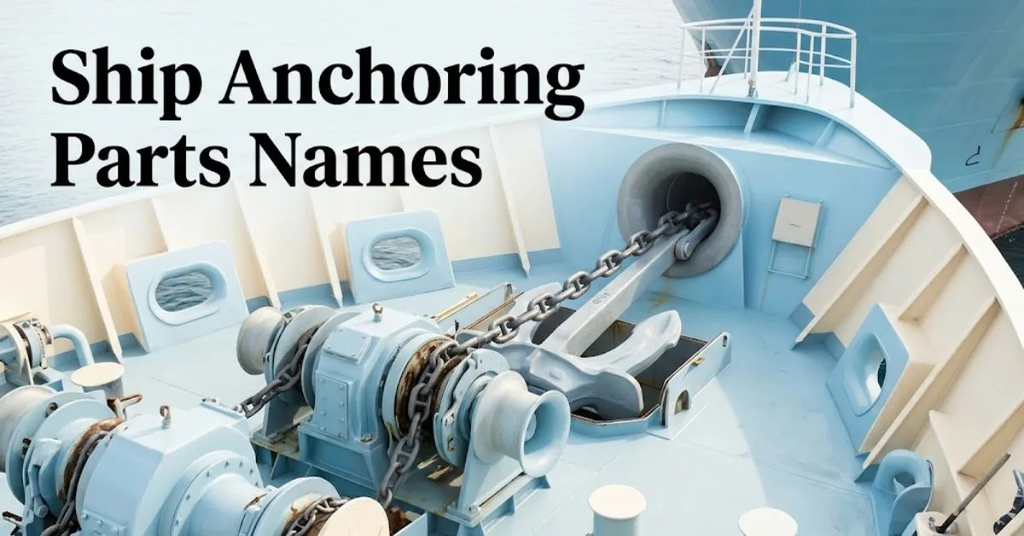
Anchoring equipment allows a vessel to remain in position when it is not intended to move freely with the water.
The principal components include the anchor, anchor chain, windlass, hawse pipe, and chain locker.
Anchor
The anchor is designed to hold the vessel against movement by engaging with the seabed.
Different anchor designs are available for different vessel types and seabed conditions.
Anchor Chain
The anchor chain connects the anchor to the ship. It provides weight and flexibility while transmitting forces between the vessel and anchor.
The length and size of chain depend on the vessel and anchoring requirements.
Windlass
A windlass is machinery used to handle the anchor and chain. It can lower, raise, and secure the anchoring equipment.
On large ships, the windlass is a substantial piece of deck machinery.
Hawse Pipe
The hawse pipe is an opening through which the anchor chain passes between the deck and the outside of the hull.
Its design helps guide and protect the chain during anchoring operations.
Ship Navigation Parts Names
Modern ships rely on sophisticated navigation equipment to determine position, monitor surroundings, communicate, and plan routes.
Common navigation equipment includes radar, GPS/GNSS receivers, electronic chart systems, compasses, depth sounders, and automatic identification systems.
Bridge
The bridge is the command and navigation area of a ship. Officers use it to monitor the vessel, control navigation, communicate, and make operational decisions.
Modern bridges may contain radar displays, electronic navigation systems, steering controls, communications equipment, and other instruments.
Radar
Marine radar uses radio waves to detect objects and estimate their range and bearing.
It is particularly useful for maintaining situational awareness in conditions where visibility may be limited.
Compass
A ship’s compass provides directional information. Modern vessels may use magnetic and gyrocompass systems along with electronic heading sensors.
GPS and GNSS
GPS and other GNSS systems provide positioning information using satellite navigation signals.
Navigation systems can combine this information with electronic charts and other sensors to help crews monitor the ship’s location.
AIS
The Automatic Identification System (AIS) allows appropriately equipped vessels and shore stations to exchange information such as vessel identity, position, course, and speed.
AIS is an important situational-awareness tool, although it should not be treated as a replacement for visual lookout, radar, or other navigation methods.
Ship Communication Parts Names
Communication equipment allows the crew to communicate with other vessels, ports, shore stations, and maritime authorities.
VHF Radio
Marine VHF radio is widely used for short-range maritime communication. It is especially important for ship-to-ship and ship-to-shore communications.
Satellite Communication
Larger vessels may use satellite communication systems for voice, data, internet connectivity, operational information, and communication with shore-based organizations.
Antennas
Ships have numerous antennas associated with communications, navigation, satellite systems, and other electronic equipment.
Their positions and designs depend on the equipment they support.
Ship Safety Equipment Names
Safety equipment is essential because ships operate in environments where emergency assistance may be far away.
Common safety equipment includes lifeboats, life rafts, life jackets, emergency position-indicating radio beacons, fire extinguishers, alarms, and emergency communication equipment.
Lifeboat
A lifeboat is a survival craft designed to carry people away from a vessel during an emergency.
Lifeboats are normally stored in dedicated launching positions and are maintained according to applicable safety requirements.
Life Raft
A life raft provides another form of survival craft. Inflatable life rafts can be stored in compact containers and deployed when required.
Life Jacket
A life jacket provides flotation to help keep a person afloat in the water.
Different vessels may carry different approved personal flotation devices depending on their operations and applicable regulations.
EPIRB
An Emergency Position-Indicating Radio Beacon (EPIRB) is designed to transmit an emergency signal that can assist search-and-rescue authorities in locating a vessel or survival craft.
Ship Engine Room Parts Names
The engine room contains many of the systems required to generate power, propel the ship, control temperature, manage fluids, and support onboard operations.
Typical machinery may include the main engine, generators, pumps, boilers or heat-recovery equipment, compressors, fuel systems, cooling systems, and electrical equipment.
Auxiliary Engine
Auxiliary engines or generators provide electrical power for systems that operate while the ship is underway or alongside.
These systems can supply electricity for lighting, navigation equipment, pumps, accommodation, cargo systems, and other onboard loads.
Pumps
Ships use numerous pumps for fuel, seawater, freshwater, bilge water, cooling systems, ballast, and other fluids.
Different pumps are selected according to the fluid, pressure, flow rate, and operational requirement.
Boiler
Some vessels use boilers to produce steam or hot water for heating, cargo operations, fuel treatment, or other onboard purposes.
The exact role of a boiler depends on the ship’s propulsion and machinery arrangement.
Ship Cargo Parts Names
Cargo vessels use specialized spaces and equipment to safely load, transport, secure, and unload goods.
The specific components depend heavily on the type of cargo ship.
Cargo Hold
A cargo hold is an enclosed space used for carrying cargo. Dry bulk carriers, for example, use large holds to transport commodities such as grain, coal, and mineral products.
Cargo Tank
Tankers use cargo tanks to transport liquid cargo.
These tanks are designed around the properties of the cargo and the vessel’s operational and safety requirements.
Cargo Crane
Some ships have onboard cargo cranes used for loading and unloading goods.
The capacity and arrangement of cranes vary according to the vessel’s trade and cargo-handling needs.
Ship Accommodation Parts Names
Passenger ships, commercial vessels, and many working ships contain accommodation spaces for people onboard.
These areas may include cabins, mess rooms, kitchens, bathrooms, lounges, offices, and recreational spaces.
Crew Cabin
A crew cabin provides sleeping and personal space for members of the crew.
The size and arrangement of cabins vary according to vessel type, capacity, regulations, and company standards.
Galley
The galley is the ship’s kitchen. It is responsible for preparing food for passengers or crew.
Large ships can have substantial galley facilities capable of preparing meals for hundreds or even thousands of people.
Mess Room
A mess room is a designated dining area for crew members.
Depending on the ship, separate dining spaces may be provided for different groups onboard.
Ship Parts Names by Vessel Type
Not every ship has exactly the same components. A container ship, tanker, bulk carrier, cruise ship, ferry, and naval vessel are designed for different purposes.
| Ship Type | Important Specialized Parts |
| Container Ship | Container holds, hatch covers, lashing equipment |
| Tanker | Cargo tanks, cargo piping, pumps |
| Bulk Carrier | Cargo holds, hatch covers, cargo handling systems |
| Cruise Ship | Passenger decks, cabins, lifeboats, entertainment areas |
| Ferry | Vehicle decks, passenger spaces, ramps |
| Tugboat | Powerful propulsion, towing equipment, winches |
| Fishing Vessel | Fishing gear, processing areas, specialized deck equipment |
| Naval Ship | Weapons systems, sensors, command spaces |
Ship Parts Names Diagram Terms
When reading a ship parts diagram, several directional terms appear repeatedly. Understanding these terms makes technical illustrations much easier to follow.
The bow is at the front, the stern is at the rear, port is the left side when facing forward, and starboard is the right side. Forward means toward the bow, while aft means toward the stern.
Vertical terminology is also useful. Above deck refers to areas higher than the deck, while below deck refers to interior spaces beneath it. The waterline indicates the approximate boundary between the portion of the hull above water and the portion below water.
Most Important Ship Parts and Their Functions
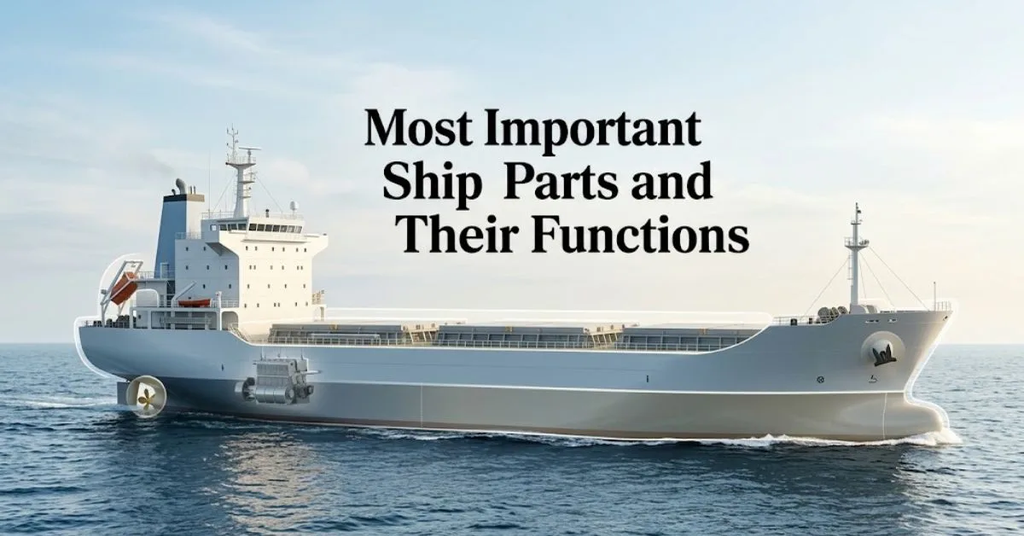
For beginners, it can be helpful to remember the core components first rather than trying to memorize every technical term.
| Ship Part | Main Function |
| Bow | Cuts through the water |
| Stern | Rear section of vessel |
| Hull | Provides buoyancy and structural enclosure |
| Keel | Provides longitudinal structural support |
| Deck | Provides horizontal working or living surfaces |
| Engine | Generates propulsion power |
| Propeller | Converts rotation into thrust |
| Rudder | Helps steer the vessel |
| Anchor | Holds vessel in position |
| Bridge | Navigation and command center |
| Radar | Detects surrounding objects |
| Lifeboat | Emergency survival craft |
| Bulkhead | Divides internal spaces |
| Cargo Hold | Stores cargo |
| Windlass | Handles anchor and chain |
How Ship Parts Work Together
A ship’s components are not independent. They form interconnected systems that allow the vessel to float, move, steer, communicate, and operate safely.
For example, the engine produces mechanical power, the shafting transfers that power, and the propeller creates thrust. At the same time, the rudder and steering gear influence the ship’s direction. Navigation systems provide information that helps the crew decide where and how to travel.
The hull supports this entire arrangement. Its structural framework carries loads while compartments and bulkheads organize the interior. Pumps manage fluids, generators supply electricity, and safety equipment provides emergency protection.
Understanding these relationships is one of the easiest ways to move from simply memorizing ship parts names to actually understanding ship anatomy.
Common Ship Parts Names for Students
Students often encounter ship terminology in maritime studies, geography, engineering, naval architecture, and transportation courses.
The most important beginner terms are bow, stern, port, starboard, hull, keel, deck, bridge, mast, anchor, rudder, propeller, engine, bulkhead, cargo hold, and lifeboat.
A useful study method is to imagine standing on the ship and identify each component according to its location. Start at the bow, move toward the stern, then learn the major components above and below the deck.
Why Learning Ship Parts Names Matters
Knowing maritime terminology improves communication and helps people understand ship diagrams, technical documents, safety instructions, and educational materials.
For students, the vocabulary provides a foundation for studying naval architecture and marine engineering. For travelers and boating enthusiasts, it makes conversations about vessels easier to understand.
Even a basic understanding of ship anatomy can make a visit to a maritime museum, historic vessel, harbor, or cruise ship more interesting because familiar terms suddenly have a physical reference.
Conclusion
Learning ship parts names becomes much easier when the vessel is viewed as a collection of connected systems rather than a list of unfamiliar nautical words. The bow and stern define the front and rear, while port and starboard identify the sides. The hull provides the main structure, the keel contributes structural strength, and the deck creates important working and accommodation areas.
The propulsion systemincluding the engine, shaft, and propeller moves the ship, while the rudder and steering gear help control its direction. The bridge and navigation equipment support safe operation, and anchors, lifeboats, communication systems, and emergency equipment contribute to overall maritime safety.
Once you know these fundamental terms, ship diagrams and more advanced maritime terminology become considerably easier to understand. From a small working boat to a massive ocean-going cargo vessel, the same basic principles of structure, propulsion, steering, navigation, and safety provide the foundation for understanding how ships operate.
FAQs
What are the main parts of a ship?
The main parts include the bow, stern, hull, keel, deck, bridge, engine, propeller, rudder, anchor, bulkheads, cargo spaces, and navigation equipment. The exact components vary according to the ship’s size and purpose.
What is the front part of a ship called?
The front part of a ship is called the bow. Its shape is designed to move efficiently through water and is influenced by the vessel’s intended speed and operating conditions.
What is the back of a ship called?
The back of a ship is called the stern. It commonly contains or supports important propulsion and steering components.
What are the left and right sides of a ship called?
The left side when facing the bow is called port, while the right side is called starboard.
What is the bottom backbone of a ship called?
The keel is traditionally described as the ship’s longitudinal backbone. Modern vessels use complex structural arrangements around the keel and bottom structure.
What part of a ship makes it move?
The propulsion system makes the ship move. In a conventional vessel, the engine provides power, the shaft transfers rotational energy, and the propeller produces thrust.
What part of a ship controls direction?
A rudder is a major steering component. It changes the direction of water flow around the stern and helps turn the vessel.
What is the command center of a ship called?
The bridge is the primary command and navigation area. Officers use it to operate and monitor the vessel and its navigation systems.
What holds a ship in place?
An anchor and anchor chain can hold a ship in position when properly deployed in suitable conditions. The windlass is used to handle the anchor and chain.
What is the inside of a ship called?
There is no single term for the entire inside of a ship. Interior areas are divided into spaces such as engine rooms, cargo holds, tanks, accommodation areas, machinery spaces, and compartments.

Liam Anderson is a passionate cat lover and the creator of OringeCatsNames. He enjoys sharing unique orange cat name ideas, pet tips, and helpful content to make life easier for cat owners around the world.