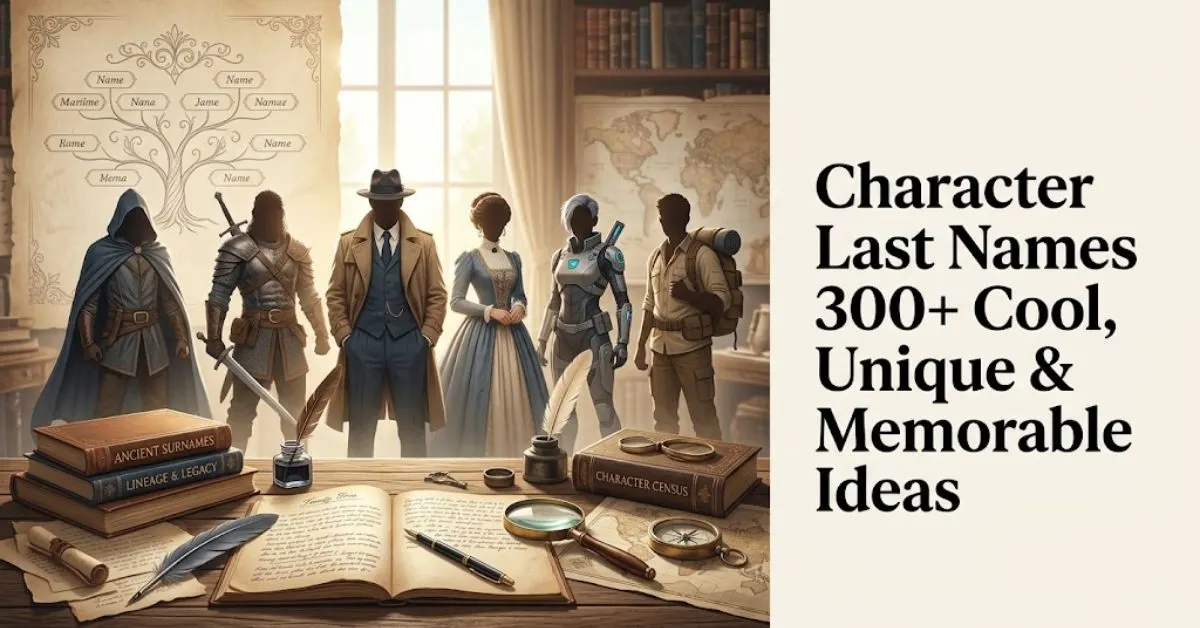
Character Last Names 300+ Cool, Unique & Memorable Ideas
The right character last names can make a fictional person feel believable, memorable, and completely at home in their story. Whether you are naming a protagonist, villain, hero, romantic lead, fantasy warrior, or game character, the surname should work with the first name, personality, setting, and genre.
After studying current character-naming resources and real U.S. surname data, one pattern stands out: the strongest fictional surnames are not always the strangest. A name becomes powerful when it feels natural for the person carrying it. That means considering pronunciation, rhythm, cultural background, historical period, story setting, and the emotional impression you want readers to receive.
Last Names for Characters
Good character last names can quietly communicate identity before a character even speaks. A surname such as Hawthorne, Sterling, Mercer, Rivers, or Blackwood creates a different impression from Smith or Brown. The choice can suggest sophistication, mystery, strength, nature, history, or ordinary realism without explaining everything directly.
When building a fictional character, consider the complete name rather than judging the surname alone. Elena Sinclair, Marcus Stone, and Maya Rivers each create different expectations. Think about sound, syllable count, spelling, cultural context, and whether the surname belongs naturally in the world of the story.
| Character style | Surname ideas |
| Modern | Carter, Hayes, Parker, Bennett, Morgan |
| Literary | Hawthorne, Dalloway, Gatsby, Tennyson, Emerson |
| Mysterious | Blackwood, Raven, Graves, Voss, Sinclair |
| Nature-inspired | Rivers, Woods, Stone, Reed, Willow |
| Powerful | Sterling, Knox, Armstrong, Cannon, Wolf |
| Elegant | Beaumont, Laurent, Sinclair, Montague, Ellington |
| Fantasy | Ravencrest, Stormvale, Ironwood, Starfall, Emberfall |
| Realistic | Miller, Carter, Davis, Wilson, Parker |
A useful rule is to make the surname distinctive without becoming distracting. Readers encounter names repeatedly in dialogue, narration, chapter headings, messages, and descriptions. If a surname is impossible to pronounce or constantly requires explanation, its uniqueness may become a storytelling obstacle rather than an advantage.
Last Names for Male Characters
Male character surnames can be strong, traditional, modern, understated, or distinctive depending on the role. Options such as Carter, Hayes, Walker, Mercer, Lawson, Brooks, Grant, Pierce, Harrison, and Vaughn can fit contemporary fiction without making the character sound exaggerated.
For realistic American characters, familiar surnames can actually strengthen authenticity. The U.S. Census Bureau’s 2020 data lists Smith, Johnson, Williams, Brown, and Jones as the five most common U.S. surnames. That gives writers a useful reference when deciding whether a character should blend naturally into an ordinary setting or stand out more clearly.
| Male character type | Last name ideas |
| Hero | Sterling, Grant, Lawson, Walker, Pierce |
| Detective | Mercer, Hayes, Rhodes, Parker, Reed |
| Romantic lead | Bennett, Sullivan, Calloway, Hart, Monroe |
| Action character | Knox, Steele, Cross, Ryder, Stone |
| Academic | Bellamy, Edison, Milton, Newton, Tennyson |
| Ordinary character | Miller, Brown, Davis, Wilson, Carter |
Try saying the entire name aloud. Ethan Mercer has a different rhythm from Ethan Montgomery, while Lucas Reed feels quicker than Lucas Wellington. Neither style is automatically better; the right choice depends on the character’s age, world, personality, and narrative role.
Last Names for Female Characters
Female character surnames do not need to sound delicate or traditionally feminine. Names such as Harper, Quinn, Monroe, Sinclair, Kennedy, Marlowe, Cassidy, Hartley, Sloane, and Bellamy can support characters who are elegant, ambitious, mysterious, athletic, rebellious, scholarly, or ordinary.
The most convincing combination usually comes from balancing the first and last names. A short first name may work beautifully with a longer surname, while a dramatic first name may benefit from something simpler. Consider rhythm, repeated sounds, spelling, cultural context, and how naturally the full name would appear in dialogue.
| Character personality | Surname ideas |
| Elegant | Sinclair, Beaumont, Laurent, Ellington |
| Strong | Sterling, Maddox, Stone, Hart |
| Mysterious | Raven, Blackwood, Voss, Graves |
| Romantic | Monroe, Bellamy, Valentine, Delaney |
| Modern | Harper, Quinn, Kennedy, Parker |
| Literary | Marlowe, Hawthorne, Dalloway, Emerson |
For example, Sofia Marlowe has a flowing literary quality, while Sofia Stone sounds shorter and more direct. The surname becomes part of characterization because readers repeatedly hear and see it. A well-balanced full name should feel like something the character could realistically carry throughout an entire story.
Last Names for Cool Characters
Cool character surnames usually work through simplicity. Names such as Ryder, Chase, Wilder, Knox, Cross, Steele, Hayes, Storm, West, and Vale can create attitude without requiring an elaborate explanation. Short names often have a strong visual and phonetic impact when repeated throughout dialogue.
The key is avoiding a surname that sounds like a costume. Jordan Cross can feel stylish without becoming overly theatrical, while a name containing several dramatic elements may pull attention away from the character. Cool character names work best when sound, personality, setting, and readability reinforce one another.
| Cool surname | Possible impression |
| Ryder | Adventurous |
| Knox | Sharp and confident |
| Wilder | Rebellious |
| Cross | Serious or mysterious |
| Steele | Strong |
| Vale | Quiet and sophisticated |
| Storm | Dramatic |
| West | Modern and concise |
| Stone | Tough |
| Chase | Energetic |
For a contemporary story, test the surname against the character’s environment. A rebellious high-school character, professional detective, esports player, superhero, and futuristic pilot may all need different kinds of “cool.” The best character last names fit the world instead of simply trying to sound impressive.
Last Names for Fantasy Characters
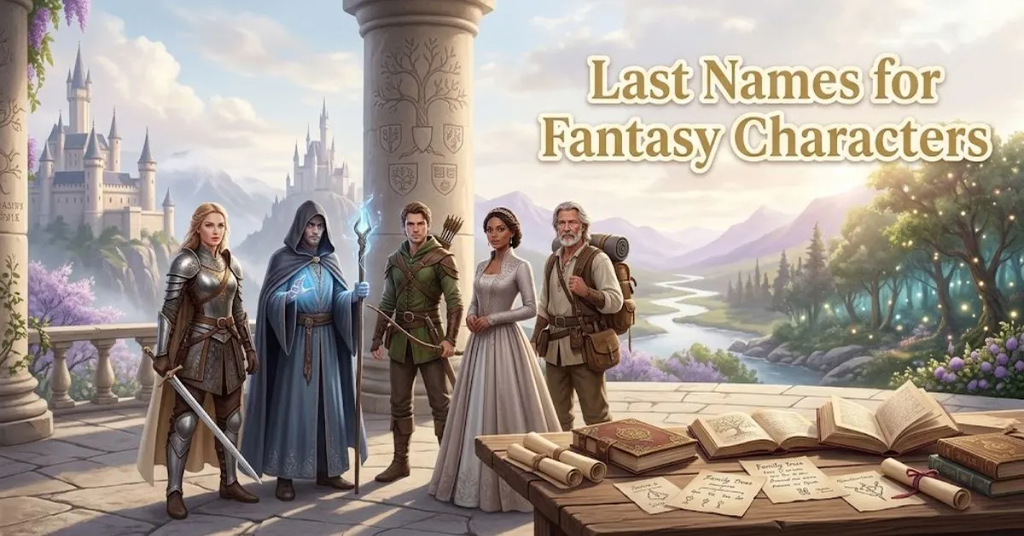
Fantasy gives writers more freedom, but good fantasy surnames still benefit from internal consistency. Names such as Ravencrest, Thornfield, Shadowmere, Stormvale, Ironwood, Frostmere, Nightwood, Silverkeep, Emberfall, and Starfall immediately suggest atmosphere.
Before creating dozens of fantasy surnames, establish a naming pattern for the fictional culture. Noble houses might use place-based names, warrior clans might use occupational or animal imagery, and ancient families might use nature-based elements. Consistency makes invented names feel as though they belong to a real linguistic system.
| Fantasy surname | Character impression |
| Ravencrest | Mysterious noble |
| Thornfield | Dangerous aristocrat |
| Shadowmere | Dark magician |
| Stormvale | Powerful warrior |
| Ironwood | Protector |
| Frostmere | Reserved mage |
| Nightwood | Gothic character |
| Silverkeep | Noble defender |
| Emberfall | Fire-associated hero |
| Starfall | Prophetic figure |
Pronunciation matters even in fantasy. A spectacular surname that readers cannot remember may become frustrating after several chapters. If the fictional world contains several families, make sure their names are distinguishable by sound, spelling, or structure.
Last Names for Unique Characters
Unique does not have to mean complicated. Strong character last names often feel unusual because they are less predictable, not because they contain strange spellings. Hawke, Rivers, Vale, Marlowe, Vesper, Arden, Lennox, Hollis, Bellamy, and Calloway can stand out while remaining easy to read.
Imagine the surname appearing fifty times throughout a novel. It needs to work in dialogue, narration, chapter titles, text messages, police reports, family conversations, and descriptions. If readers constantly stop to decode the spelling, the name creates friction. Distinctiveness should make the character easier to remember, not harder.
| Unique surname | Style |
| Vesper | Mysterious |
| Hawke | Sharp |
| Arden | Literary |
| Lennox | Modern |
| Hollis | Gentle |
| Calloway | Refined |
| Merrick | Adventurous |
| Harlow | Contemporary |
| Renshaw | Traditional |
| Westfall | Atmospheric |
Another useful distinction is rare versus invented. A writer does not always need to create a completely new surname. Real-world surname databases contain enormous variety. Uncommon authentic names can provide individuality while preserving a believable connection to the character’s cultural or historical setting.
Last Names for Pretty Characters
Pretty character surnames often have flowing sounds, balanced syllables, or associations with nature, places, light, flowers, and elegance. Options such as Rose, Marlowe, Hartley, Bellamy, Monroe, Valentine, Sloane, Delaney, Winslow, and Briar can create a softer first impression.
However, “pretty” does not mean weak. A beautiful surname can belong to a detective, athlete, villain, politician, warrior, or fantasy heroine. What matters is the interaction between the surname and the character. Valentine might sound romantic in one story but ironic or threatening in another.
| Pretty surname | Possible tone |
| Rose | Floral and familiar |
| Marlowe | Literary |
| Bellamy | Refined |
| Monroe | Glamorous |
| Valentine | Romantic |
| Hartley | Warm |
| Winslow | Classic |
| Delaney | Friendly |
| Briar | Nature-inspired |
| Celeste | Elegant |
A surname with a softer sound can also balance a stronger first name. Conversely, a delicate first name can become more memorable when paired with a surname containing harder consonants. This contrast is one of the simplest ways to create a full name that sounds intentional.
Last Names for Rich Characters
A wealthy character does not necessarily need an extravagant surname, but names such as Carrington, Kensington, Lancaster, Cavendish, Wellington, Buckingham, Davenport, Montgomery, and Worthington can evoke established families, old estates, or social prestige.
The story’s setting matters more than the stereotype. A wealthy technology founder, inherited aristocrat, celebrity, political dynasty, and affluent suburban teenager may each require a different naming style. A simple surname can sometimes feel more convincing because modern wealth does not always come with an elaborate family name.
| Character background | Surname ideas |
| Old money | Carrington, Cavendish, Wellington |
| Aristocratic | Kensington, Lancaster, Buckingham |
| Corporate | Sterling, Prescott, Davenport |
| Political dynasty | Montgomery, Hamilton, Worthington |
| Wealthy modern family | Bennett, Sinclair, Whitmore |
| Literary wealthy character | Gatsby, Ellington, Hawthorne |
Avoid using the surname as a shortcut for characterization. A name can suggest social history, but the character’s actions, relationships, environment, possessions, education, and dialogue should ultimately communicate who they are.
Last Names for Cute Characters
Cute surnames often use warm sounds, familiar imagery, or associations with nature and everyday objects. Cooper, Dawson, Finch, Clover, Rose, Honeywell, Appleton, Bailey, Poppy, Winters, Blossom, Meadow, and Willow can create a lighter emotional tone.
Cute does not have to mean childish. A cozy mystery, romantic comedy, children’s story, slice-of-life novel, or game can use a gentle surname without making the character feel immature. If the first name is already playful, a more grounded surname may create a better balance.
| Cute surname | Impression |
| Finch | Small and lively |
| Clover | Cheerful |
| Cooper | Familiar |
| Dawson | Friendly |
| Bailey | Warm |
| Poppy | Playful |
| Winters | Whimsical |
| Meadow | Soft |
| Blossom | Cheerful |
| Fairchild | Storybook |
For example, Milo Cooper feels naturally light, while a first and last name that are both extremely whimsical may sound intentionally cartoonish. Think about the emotional level of the whole name rather than choosing every component for the same reason.
Last Names for Badass Characters
Badass character surnames need presence, but they should remain readable. Savage, Steele, Knox, Hunter, Lawless, Wolf, Stone, Blackwood, Cross, Slade, Graves, Vance, Ryder, Archer, and Flint can suggest danger, resilience, confidence, independence, or physical strength.
Interestingly, contrast can make a character more compelling. A ruthless assassin named Hart may create more curiosity than someone named Savage because the surname does not immediately explain the personality. A surname works best as one storytelling layer rather than the entire character description.
| Badass surname | Possible impression |
| Knox | Controlled strength |
| Steele | Toughness |
| Lawless | Rebellion |
| Graves | Dark |
| Vance | Confident |
| Flint | Hard-edged |
| Archer | Precise |
| Blackwood | Gothic |
| Slade | Sharp |
| Cross | Serious |
Before choosing a dramatic surname, ask whether the character’s environment supports it. A superhero, assassin, military protagonist, Western outlaw, fantasy warrior, and modern teenager can all be tough without using the same naming style.
Last Names for Fancy Characters
Fancy surnames often use longer forms, historical associations, aristocratic sounds, or French and British influences. Beaumont, Carruthers, Chevalier, Montague, Versailles, Wellington, Kensington, Laurent, Sinclair, and Worthington can produce a polished first impression.
Context is essential. A nineteenth-century estate drama can support formal names naturally, while a contemporary American high-school comedy may require something more ordinary. The surname should belong to the world rather than feeling like an accessory added to make a character appear sophisticated.
| Fancy surname | Character direction |
| Beaumont | Refined |
| Carruthers | Traditional |
| Chevalier | Continental |
| Montague | Literary |
| Laurent | Elegant |
| Kensington | Aristocratic |
| Worthington | Formal |
| Devereaux | Dramatic |
| Ellington | Sophisticated |
| Pemberton | Established |
For historical fiction, research the period before using an elaborate surname. A name that sounds perfect may be culturally or historically inappropriate for a particular setting. Authenticity is more valuable than simply choosing the most decorative option.
Last Names for Rare Characters

Rare surnames can make an original character stand out, particularly when a story contains several common family names. Options such as Thoreau, Tolliver, Ellington, Courtier, Willoughby, Reinhart, Quillen, Renshaw, Varden, Zeller, Penrose, Selwyn, Treadwell, Westfall, and Huxley offer distinctive possibilities.
There is a meaningful difference between rare and invented. The U.S. Census Bureau maintains surname-frequency data from the 2020 Census, demonstrating the enormous diversity of family names in the United States. Writers can therefore find unusual real surnames without automatically creating artificial spellings.
| Rare surname | Style |
| Tolliver | Traditional |
| Ellington | Refined |
| Willoughby | Old-fashioned |
| Reinhart | European feel |
| Quillen | Distinctive |
| Renshaw | Literary |
| Varden | Fantasy-friendly |
| Penrose | Elegant |
| Westfall | Atmospheric |
| Huxley | Intellectual |
The strongest rare character names remain pronounceable and memorable. If your story is contemporary, research whether the surname has an established cultural association. If your story is fantasy or speculative fiction, inventing a surname can work—but make sure its construction follows the naming logic of that world.
Conclusion
Choosing character last names is really an exercise in storytelling. The right surname can suggest personality, background, social setting, genre, history, or mystery before the character has said a single line. Whether you need a realistic American surname, a cool modern option, a rare literary name, or a fantasy family name, focus on how the complete name serves the character.
Start with the character’s personality and world, then test the surname beside the first name. Say it aloud, check its spelling, consider its cultural context, and imagine seeing it repeatedly throughout the story. A memorable surname does not need to be complicated—it simply needs to feel like it belongs to the person carrying it.
FAQs
What makes a good last name for a character?
A good surname fits the character’s first name, personality, setting, cultural background, and genre. It should also be easy to pronounce and memorable enough for readers to recognize quickly. The strongest character last names feel natural rather than obviously constructed.
How do I choose a last name for a fictional character?
Start with the character’s setting, time period, cultural background, personality, and role. Then test several surnames with the first name aloud. Compare the rhythm, spelling, pronunciation, emotional tone, and whether the surname feels believable in the story.
Should fictional characters have real last names?
Not necessarily. Real surnames can make contemporary or historical characters feel authentic, while invented surnames can work particularly well in fantasy and speculative fiction. The important consideration is consistency with the fictional world and character background.
Should a fantasy surname have a meaning?
It can, but it does not have to. A meaningful fantasy surname works best when it subtly supports the character or fictional culture. Extremely obvious symbolism can feel heavy-handed, while a carefully chosen meaning can add an extra layer of storytelling.
How do I make a character’s surname unique?
Start with uncommon real surnames, consider historical or regional naming patterns, or carefully combine familiar linguistic elements for an invented name. Avoid unnecessary spelling complexity. A unique surname should help readers remember the character rather than forcing them to stop and decode it.
What are common American last names?
According to the U.S. Census Bureau’s 2020 Census data, the five most common U.S. surnames were Smith, Johnson, Williams, Brown, and Jones. Garcia ranked sixth, followed by Miller, Rodriguez, Davis, and Martinez.
Should the first name and last name start with the same letter?
They can, but they do not have to. Alliteration can make a fictional name memorable, such as Maya Morgan or Peter Parker, but excessive repetition can make names feel artificial. Always listen to the complete name rather than judging the initials alone.
Can I use a famous person’s surname for a fictional character?
A surname by itself is generally much less distinctive than a complete name, but writers should still check for unintended associations with real people, fictional characters, brands, or public figures. For commercial work, checking the complete character name before publication is a sensible precaution.

Liam Anderson is a passionate cat lover and the creator of OringeCatsNames. He enjoys sharing unique orange cat name ideas, pet tips, and helpful content to make life easier for cat owners around the world.