
Names of the Teeth Types, Numbers & Functions Explained
The names of the teeth are incisors, canines, premolars, and molars, and each group has a distinct position and job. If a dental chart has ever looked like a confusing collection of numbers and unfamiliar terms, you are not alone. Understanding central incisors, lateral incisors, cuspids, bicuspids, molars, wisdom teeth, maxillary teeth, and mandibular teeth makes dental terminology much easier to follow.
I have organized this guide from the center of the mouth toward the back, using the same practical sequence dentists use when describing tooth position. You will learn the tooth names, functions, U.S. numbering system, primary teeth, permanent teeth, dental anatomy, crown, root, enamel, dentin, and pulp so you can understand an X-ray, treatment plan, or dental conversation with much less guesswork.
Names of Teeth Teeth Names and Numbering
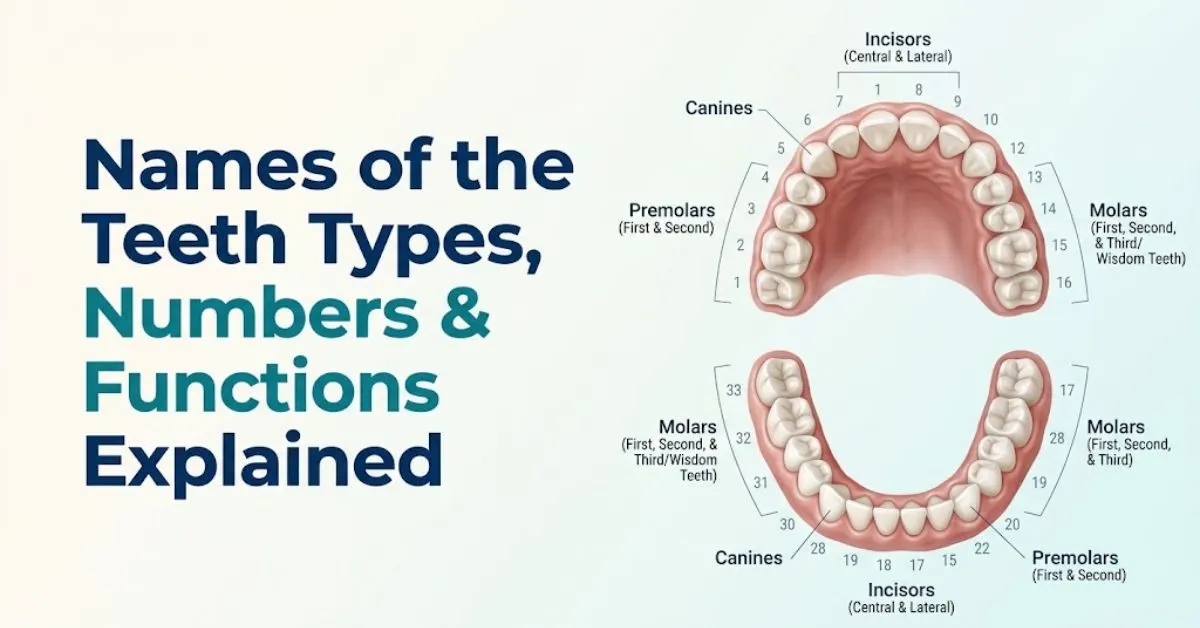
Dentists identify teeth using both names and numbers. A name describes the tooth type or position, while a number provides a precise identifier for dental charts and treatment records. In the United States, the Universal/National Tooth Numbering System is the commonly used system for permanent teeth, numbering them from 1 through 32.
The sequence begins with the upper-right third molar as tooth #1, continues across the upper arch to #16, then moves to the lower-left third molar at #17 and continues to #32. The American Dental Association recognizes this system for U.S. dental documentation, making it particularly useful when reading American dental records.
U.S. Universal Tooth Numbering Chart
| Tooth Number | Tooth Name | Location |
| #1 | Third molar | Upper right |
| #2 | Second molar | Upper right |
| #3 | First molar | Upper right |
| #4 | Second premolar | Upper right |
| #5 | First premolar | Upper right |
| #6 | Canine/cuspid | Upper right |
| #7 | Lateral incisor | Upper right |
| #8 | Central incisor | Upper right |
| #9 | Central incisor | Upper left |
| #10 | Lateral incisor | Upper left |
| #11 | Canine/cuspid | Upper left |
| #12 | First premolar | Upper left |
| #13 | Second premolar | Upper left |
| #14 | First molar | Upper left |
| #15 | Second molar | Upper left |
| #16 | Third molar | Upper left |
| #17–#32 | Lower teeth | Lower arch |
For primary teeth, U.S. dental records use letters A through T rather than numbers. This distinction matters when a parent looks at a child’s dental chart and sees letters instead of the familiar numbers used for adult teeth.
Names of Teeth: The Four Main Types of Teeth and What They Do
The four main permanent tooth groups are incisors, canines, premolars, and molars. Their different shapes reflect different mechanical jobs. Incisors have relatively sharp cutting edges, canines are pointed for gripping and tearing, while premolars and molars have broader chewing surfaces for crushing and grinding food.
Think about biting into an apple. Your incisors make the first cut. Canines can help grip and tear tougher pieces, while premolars and molars progressively crush and grind the food. Teeth therefore work as a coordinated system rather than as separate structures with unrelated functions.
| Type | Typical Adult Number | Main Function | Position |
| Incisors | 8 | Cutting and biting | Front |
| Canines | 4 | Tearing and gripping | Beside incisors |
| Premolars | 8 | Crushing and grinding | Behind canines |
| Molars | 12 | Grinding and crushing | Back of mouth |
The American Dental Association describes incisors as cutting teeth, canines as pointed tearing teeth, premolars as sharing characteristics of canines and molars, and molars as broad teeth used for crushing and grinding.
Names of Teeth: Incisors, Canines, Premolars and Molars
Incisors are the front cutting teeth and include central and lateral incisors. Canines, also called cuspids or eyeteeth, sit beside the incisors. Premolars, sometimes called bicuspids, sit behind the canines. Molars occupy the back of the mouth and include first, second, and third molars.
This front-to-back pattern is one of the easiest ways to remember the names of the teeth: central incisor → lateral incisor → canine → first premolar → second premolar → first molar → second molar → third molar. That sequence repeats on both sides of the upper and lower arches.
Names of Teeth How Teeth Are Named by Position
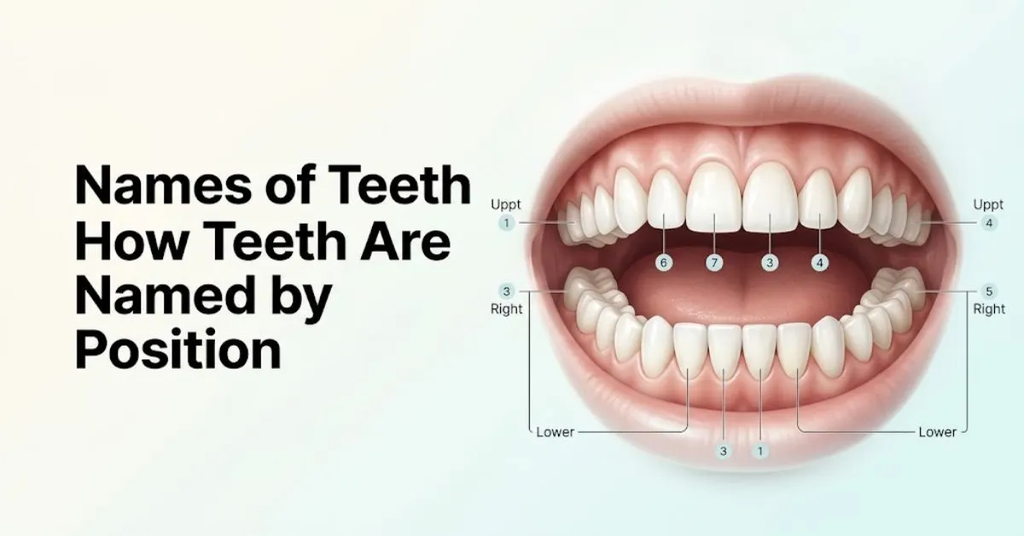
A tooth’s name can describe more than its type. Dentists can combine the jaw, side, position, and tooth group to identify a specific tooth. For example, “upper left first molar” gives much more precise information than simply saying “molar.” This terminology is especially useful when discussing X-rays and treatment plans.
Two important words are maxillary and mandibular. Maxillary means relating to the upper jaw, or maxilla, while mandibular refers to the lower jaw, or mandible. Once these terms become familiar, phrases such as “right maxillary canine” or “left mandibular molar” become much easier to understand.
Names of Teeth: Upper and Lower Teeth
The upper teeth are called maxillary teeth because they are positioned in the maxilla. The lower teeth are called mandibular teeth because they are positioned in the mandible. Each arch normally contains a symmetrical arrangement of incisors, canines, premolars, and molars.
A useful mental picture is to start at the middle of one arch and move backward. You encounter a central incisor, lateral incisor, canine, first premolar, second premolar, first molar, second molar, and third molar. The same pattern appears on the opposite side.
Names of Teeth: Baby Teeth and Adult Teeth: What Changes Over Time?
Children do not begin with the same set of teeth that adults have. A typical primary dentition contains 20 teeth: eight incisors, four canines, and eight molars. Importantly, primary teeth do not contain premolars. Permanent premolars later occupy positions previously held by primary molars.
The transition happens gradually throughout childhood. Primary teeth loosen and are shed while permanent teeth emerge. The American Dental Association notes that baby teeth begin erupting at about six months, while its eruption guidance indicates that all 32 permanent teeth have usually erupted by about age 21, although individual timing varies.
Names of Teeth: Primary and Permanent Dentition
Primary dentition means the first set of teeth, commonly called baby teeth or deciduous teeth. Permanent dentition refers to the adult set. Primary dentition contains 20 teeth, whereas a complete permanent dentition contains 32 teeth when all four third molars are present.
Primary molars eventually make way for permanent premolars, while permanent first, second, and third molars generally erupt behind the primary teeth rather than replacing them. This is one reason parents sometimes assume a child is “missing” a replacement tooth when the dental development is actually following a different sequence.
| Feature | Primary Teeth | Permanent Teeth |
| Typical total | 20 | 32 |
| Incisors | 8 | 8 |
| Canines | 4 | 4 |
| Premolars | 0 | 8 |
| Molars | 8 | 12 |
| Wisdom teeth | No | Up to 4 |
NCBI’s dental anatomy reference similarly describes primary dentition as 20 teeth and permanent dentition as 32 teeth, with permanent premolars replacing the primary molars.
Names of Teeth: How Many Teeth Do Humans Have?
Most adults have 32 permanent teeth when all four third molars are present. That total includes eight incisors, four canines, eight premolars, and twelve molars. However, 32 should be understood as the standard complete permanent dentition, not a requirement that every adult actually has 32 teeth.
Wisdom teeth are one major reason the number varies. Some people do not develop all four third molars, while others have them removed or have teeth that remain impacted. NIDCR and other medical references therefore commonly describe the adult total as 28 to 32 teeth depending on the presence of third molars.
Names of Teeth: Adult Teeth Chart
| Individual Tooth | Number in Full Adult Dentition | Function |
| Central incisors | 4 | Bite and cut |
| Lateral incisors | 4 | Bite and cut |
| Canines | 4 | Grip and tear |
| First premolars | 4 | Crush |
| Second premolars | 4 | Crush and grind |
| First molars | 4 | Grind |
| Second molars | 4 | Grind |
| Third molars | Up to 4 | Additional grinding |
The simplest memory pattern is 2 incisors + 1 canine + 2 premolars + 3 molars per quadrant. Four quadrants produce the complete 32-tooth permanent arrangement. NCBI’s dental anatomy material describes this same organization from the midline toward the back of each quadrant.
Names of Teeth: Basic Tooth Anatomy Patients Should Know
Knowing tooth names becomes much easier when you understand that every tooth also has a physical structure. The visible portion is the crown, while the root extends into the jaw. The crown is primarily protected by enamel, while dentin lies beneath it and surrounds the pulp.
The pulp contains nerves and blood vessels, while cementum covers the root and contributes to attachment. The periodontal ligament helps connect the tooth to its supporting tissues. These structures explain why a dentist may describe a problem as affecting enamel, dentin, pulp, root, or supporting tissues rather than simply “the tooth.”
Names of Teeth: Crown, Enamel, Dentin, Pulp and Root
The crown is the portion normally visible above the gumline. Enamel covers the crown and provides a hard protective surface. Dentin lies underneath enamel, while the pulp occupies the central space and contains nerves and blood vessels. The root anchors the tooth within its supporting structures.
The ADA’s tooth-anatomy material identifies enamel, dentin, cementum, pulp, the crown, root canal, periodontal ligament, and surrounding structures as important components of tooth anatomy.
| Tooth Part | Basic Role |
| Crown | Visible portion of the tooth |
| Enamel | Protective outer covering of crown |
| Dentin | Main hard tissue beneath enamel |
| Pulp | Contains nerves and blood vessels |
| Root | Anchors the tooth |
| Cementum | Covers the root |
| Periodontal ligament | Helps attach tooth to supporting bone |
This anatomy also explains why symptoms can feel different. A superficial problem involving the outer surface is not necessarily the same as a problem that reaches deeper tissues. Persistent pain, swelling, sensitivity, or a broken tooth deserves professional dental evaluation.
Names of Teeth: Why Knowing Teeth Names Matters in Dental Care
You do not need to become a dental professional to benefit from knowing the names of your teeth. Imagine a dentist saying, “There is a cavity on your lower-left first molar.” If you know the tooth sequence, you immediately understand that the dentist is referring to a back chewing tooth rather than one of your front teeth.
This vocabulary can also make dental X-rays, treatment plans, insurance documents, and second opinions easier to understand. Knowing the difference between a canine, premolar, and molar helps you ask better questions and follow explanations without feeling as though every dental term is a foreign language.
Tooth numbers are especially useful in U.S. dentistry because the Universal/National system provides a standardized identifier. The ADA describes it as the numbering system most commonly used by dental professionals in America.
If a dentist mentions #8, for example, the U.S. Universal system identifies it as the upper-right central incisor. If the dentist mentions #19, that identifies the lower-left first molar. Understanding those references can make a dental visit considerably less confusing.
What is tooth #8?
In the U.S. Universal Numbering System, tooth #8 is the upper-right central incisor. It is one of the two central incisors in the upper arch.
What is tooth #19?
Tooth #19 is the lower-left first molar in the U.S. Universal Numbering System. It is one of the major permanent chewing teeth.
What are the teeth numbers in the U.S.?
Permanent teeth are numbered 1 through 32 in the Universal/National system. The sequence begins at the upper-right third molar, moves across the upper arch, then continues around the lower arch. Primary teeth are designated with letters A through T.
What are the names of all 32 teeth?
A complete adult set contains:
- 4 central incisors
- 4 lateral incisors
- 4 canines
- 4 first premolars
- 4 second premolars
- 4 first molars
- 4 second molars
- Up to 4 third molars
The third molars are commonly called wisdom teeth.
Names of Teeth Quick Reference
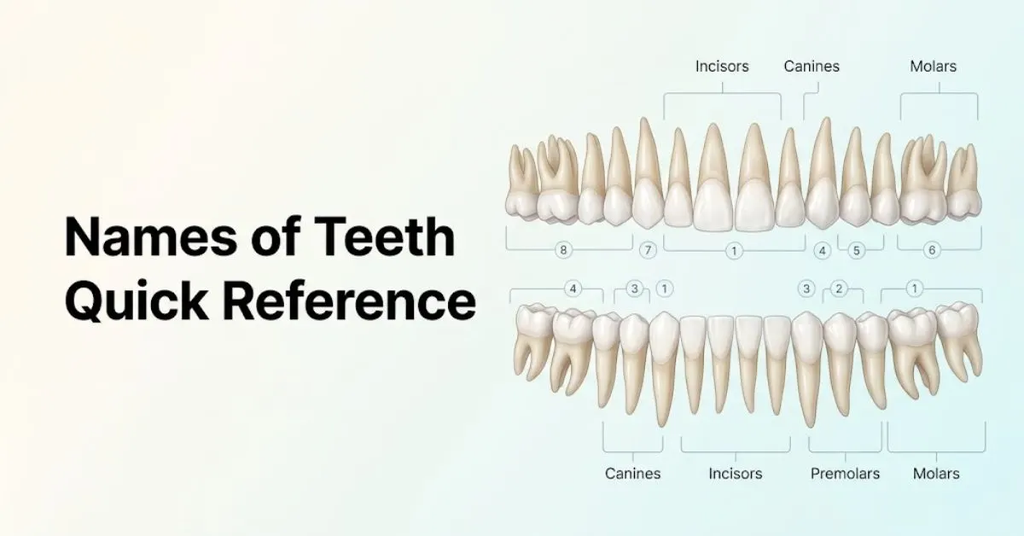
If you only remember one pattern, remember the sequence from the middle of the mouth toward the back:
Central incisor → Lateral incisor → Canine → First premolar → Second premolar → First molar → Second molar → Third molar
The functional shortcut is equally simple:
Incisors cut → Canines tear → Premolars crush → Molars grind.
For the upper jaw, think maxillary. For the lower jaw, think mandibular. For the final molars, think third molars or wisdom teeth.
A complete adult dentition can contain 32 permanent teeth, while primary dentition normally contains 20 teeth. Once this pattern clicks, a dental chart stops looking like a wall of mysterious terminology and starts looking like a simple map of the mouth.
Understanding the names of the teeth can also make conversations about dental X-rays, cavities, crowns, fillings, orthodontic treatment, wisdom teeth, and routine examinations easier to follow. The goal isn’t to memorize every dental term; it is to understand enough of the system to communicate clearly with your dental professional.
Conclusion
Understanding the names of the teeth makes dental terminology much easier to follow, whether you are learning basic tooth anatomy, reading a dental chart, or preparing for a conversation with your dentist. The four main typesincisors, canines, premolars, and molars each have a distinct shape and function, while tooth numbering systems help identify individual teeth accurately.
From the 20 primary teeth children develop to the 32 permanent teeth commonly found in adults, every tooth has an important role in biting, tearing, chewing, and maintaining a healthy bite. Knowing terms such as crown, enamel, dentin, pulp, root, upper teeth, and lower teeth can also help you better understand dental records and treatment plans. Use the tooth charts and numbering information in this guide as a quick reference whenever you need to identify a specific tooth or understand its purpose.
FAQs
What are the main teeth names?
The four main permanent tooth types are incisors, canines, premolars, and molars. Incisors primarily cut, canines help grip and tear, premolars crush, and molars provide broad surfaces for heavier grinding.
How many teeth do adults usually have?
A complete permanent dentition contains 32 teeth, including four third molars or wisdom teeth. Some adults have fewer than 32 because wisdom teeth may never develop, remain impacted, have been removed, or other teeth may have been lost.
How many teeth do children have?
Children normally have 20 primary teeth: eight incisors, four canines, and eight molars. Primary teeth do not include premolars. As permanent teeth develop, the primary dentition is gradually replaced.
What is the difference between premolars and molars?
Premolars sit between the canines and molars and generally have intermediate-sized chewing surfaces. Molars are larger back teeth with broader surfaces designed primarily for crushing and grinding food.
Are wisdom teeth considered molars?
Yes. Wisdom teeth are third molars. They are the teeth farthest toward the back of each permanent dental arch. Not everyone develops all four, and some remain impacted or are removed.
Why do dentists use numbers as well as teeth names?
Numbers allow dentists to identify individual teeth quickly and consistently in charts, X-rays, treatment records, and insurance documentation. Names explain the type and location, while numbering provides a standardized identifier.
What is an eyetooth?
An eyetooth is an informal term for a canine, particularly an upper canine. The professional dental terms are generally canine or cuspid.
What are premolars also called?
Premolars are commonly called bicuspids. They sit between the canines and molars and contribute to crushing and grinding food. The term “bicuspid” is common, although tooth cusp shapes can vary.
What are the front teeth called?
The front teeth are primarily the incisors. Each arch has central incisors near the midline and lateral incisors beside them. These teeth are especially important for biting and cutting food.
What are the back teeth called?
The back teeth include the premolars and molars. Premolars are located behind the canines, while molars occupy the most posterior portions of the dental arches.

Liam Anderson is a passionate cat lover and the creator of OringeCatsNames. He enjoys sharing unique orange cat name ideas, pet tips, and helpful content to make life easier for cat owners around the world.