Names of Teeth in Mouth Types, Numbers & Functions
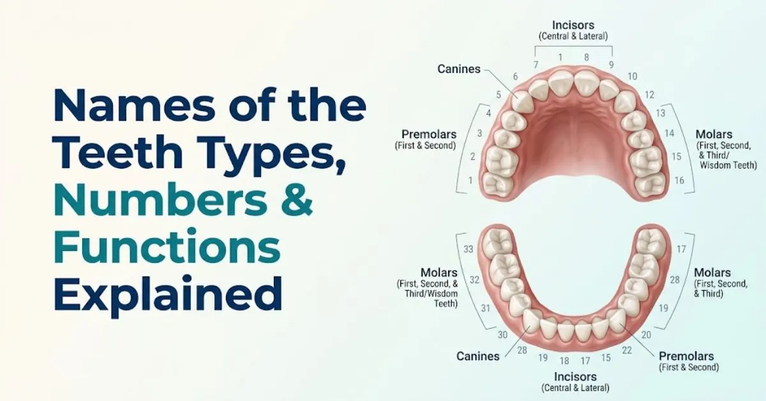
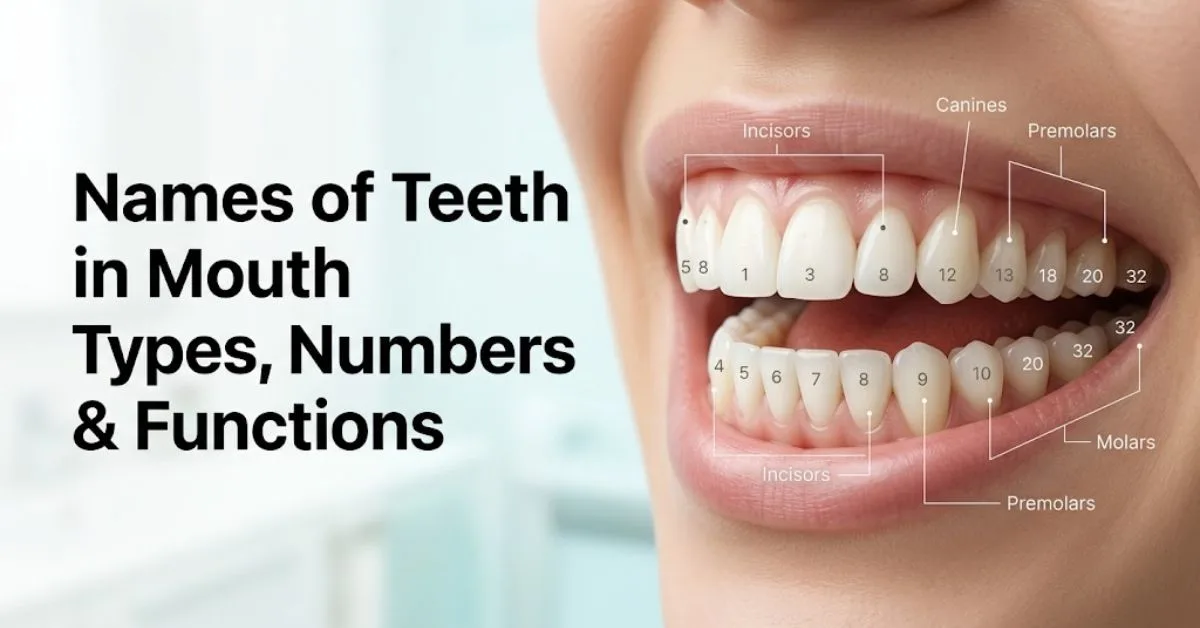
The names of teeth in mouth are mainly incisors, canines, premolars, and molars, with each type designed for a different job. Incisors cut, canines tear, premolars crush, and molars grind. Most adults have up to 32 permanent teeth, while children typically have 20 primary teeth. Understanding this simple pattern makes dental charts, X-rays, and conversations with your dentist much easier.
When I explain dental anatomy, the easiest approach is to picture the mouth from front to back central incisors, lateral incisors, canines, first and second premolars, then first, second, and third molars. That sequence connects tooth position, function, terminology, and numbering. The result is a much clearer mental map of the oral cavity rather than a confusing collection of dental words.
Names of Teeth in Mouth A Simple Tooth Chart
The easiest way to learn the names of teeth in mouth is to organize them by type, number, location, and function. A typical permanent dentition has 8 incisors, 4 canines, 8 premolars, and 12 molars when all third molars are present.
| Tooth type | Number in adults | Location | Main function |
| Incisors | 8 | Front | Biting and cutting |
| Canines | 4 | Beside incisors | Tearing and gripping |
| Premolars | 8 | Behind canines | Crushing and grinding |
| Molars | Up to 12 | Back of mouth | Grinding and chewing |
The sequence becomes especially useful when looking at a dental chart central incisor → lateral incisor → canine → first premolar → second premolar → first molar → second molar → third molar. This arrangement occurs in each quadrant of the permanent dentition. Kenhub and Cleveland Clinic independently describe the same four major tooth groups and their distribution.
| Position from the center | Tooth name |
| 1 | Central incisor |
| 2 | Lateral incisor |
| 3 | Canine |
| 4 | First premolar |
| 5 | Second premolar |
| 6 | First molar |
| 7 | Second molar |
| 8 | Third molar / wisdom tooth |
This chart is useful because a dentist may use either a common name or a more precise position. “Upper right first molar,” for example, identifies a specific back tooth, while “molar” describes a broader group. That distinction becomes important when reading X-rays, treatment plans, or dental records.
Names of Teeth in Mouth What Are Incisors?
What are incisors?
Incisors are the front teeth of the mouth. A typical permanent set contains eight four in the upper jaw and four in the lower jaw. Their relatively thin, sharp edges are adapted for cutting and biting food before the material moves toward the posterior chewing teeth.
If you bite into an apple, sandwich, or carrot, your incisors usually make the first contact. They are positioned at the front of the dental arch and are also important for speech and appearance. Their visible location explains why chipped or damaged incisors can be particularly noticeable.
Central incisors and lateral incisors
The two front teeth closest to the middle line of each jaw are called central incisors. Beside them are the lateral incisors. Together, these make eight permanent incisors four central and four lateral. The terminology simply describes their position within the dental arch.
Think of the four upper front teeth as a small team the two central incisors sit in the middle, while the lateral incisors sit immediately beside them. The same arrangement appears in the lower arch. This positional naming system helps dentists describe an exact tooth without relying on vague phrases such as “front tooth.”
What do incisors do?
The main job of incisors is biting and cutting. Their thin incisal edges are suited to slicing food into pieces that can then be handled by the canines, premolars, and molars. Incisors also contribute to speech and help support the appearance and contour of the lips.
Their role is easy to remember incisors initiate the bite. They are not intended to perform all chewing by themselves. Once food has been cut, the tongue and other teeth move and process it. This division of labor explains why teeth have such different shapes even though they share the same basic purpose.
Names of Teeth in Mouth What Are Canines?
What are canines?
Canines are the four pointed teeth positioned between the lateral incisors and premolars. Adults normally have one canine in each quadrant of the mouth. They are sometimes called cuspids or, informally, “eye teeth,” particularly when referring to the upper canines.
Their pointed crowns make canines visually different from flat-edged incisors and broad posterior teeth. They form an important transition between the front cutting teeth and the back chewing teeth. Their shape helps them grip and tear food while also contributing to the guidance of jaw movement.
What is the function of canine teeth?
The primary function of canine teeth is gripping and tearing food. Their pointed shape provides a firm contact point when food needs to be held or separated. Canines also participate in guiding the movement of the teeth as the upper and lower jaws come together.
Imagine biting into a firm piece of food that needs to be torn rather than simply sliced. The incisors begin the process, while the canines help grip and tear. Premolars and molars then take over much of the crushing and grinding. Each tooth group therefore contributes a different mechanical action.
Why are canines called eye teeth?
The informal term “eye teeth” generally refers to the upper canines because of their position beneath the eye region. It is not the name of a separate tooth type. Dentists normally use “canine” or “cuspid” when identifying these teeth professionally.
Knowing both terms can make dental conversations less confusing. If someone says “eye tooth,” they usually mean an upper canine. If a dental record says “canine” or “cuspid,” it refers to the same general tooth group. The difference is primarily everyday language versus professional terminology.
Names of Teeth in Mouth What Are Premolars?
What are premolars?
Premolars are the permanent teeth located between the canines and molars. Adults normally have eight premolars, with two in each quadrant a first premolar and a second premolar. They are sometimes called bicuspids, although tooth shape can vary.
Premolars are broader than incisors and canines but generally smaller than molars. Their position and shape give them an intermediate role in chewing. They can help hold, crush, and grind food, creating a smooth transition from the tearing action of the canine teeth to the heavier grinding performed farther back.
First and second premolars
Each quadrant of the permanent mouth contains a first premolar followed by a second premolar. These teeth sit directly behind the canine and immediately before the first molar. Their names therefore tell you both the tooth category and its position in the sequence.
A useful memory trick is to count backward from the molars second premolar comes closest to the first molar, while first premolar sits closer to the canine. Importantly, primary teeth do not have premolars. Permanent premolars develop as part of the transition from primary to permanent dentition.
What is the function of premolars?
Premolars help crush and grind food using their raised chewing surfaces and cusps. Their intermediate size allows them to perform more demanding chewing than incisors and canines while still sharing some functional characteristics with the teeth farther forward.
When you chew something such as bread, fruit, vegetables, or cooked meat, premolars help break larger pieces into smaller ones. The tongue continually repositions food, allowing different teeth to contact it. This coordinated process is why chewing is a whole-mouth activity rather than a job performed by one tooth type.
Names of Teeth in Mouth What Are Molars?
What are molars?
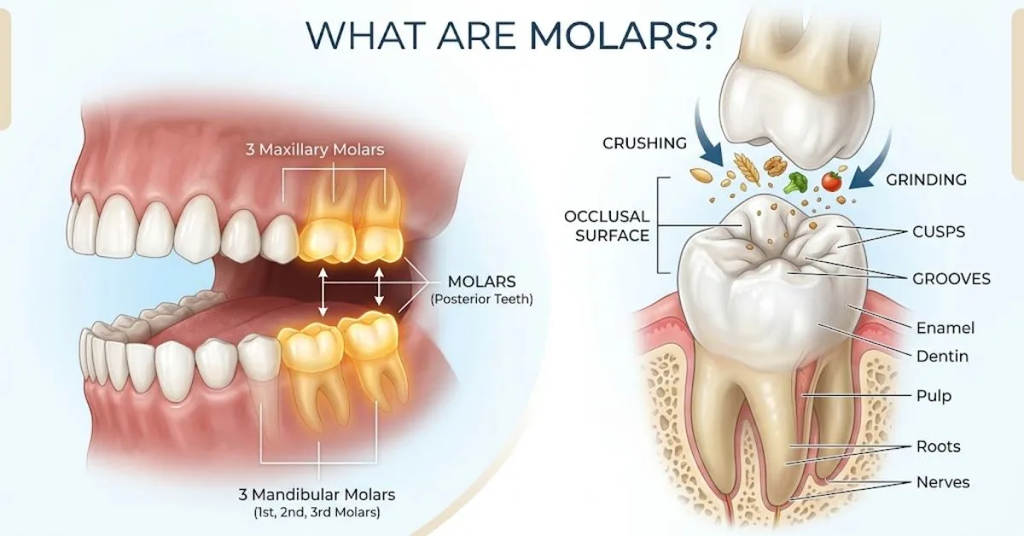
Molars are the broad, strong teeth toward the back of the mouth. A complete permanent dentition can contain up to 12 molars first, second, and third molars in each quadrant. Their broad chewing surfaces are especially suited to crushing and grinding food.
Because molars sit farthest back, they can be harder to clean thoroughly. Their grooves, ridges, and cusps provide useful chewing surfaces but can also retain food debris and plaque. This makes careful brushing and cleaning especially important around the posterior teeth.
First molars and second molars
The first molars are positioned immediately behind the second premolars, followed by the second molars. First permanent molars are often called “six-year molars” because they commonly erupt around the early school years, while second molars are sometimes associated with the “12-year molar” stage.
These age-based nicknames are useful memory aids, not strict deadlines. Tooth eruption varies between individuals. What matters is the overall development pattern and whether a dental professional identifies a concern such as delayed eruption, crowding, or abnormal positioning.
Wisdom teeth and third molars
Wisdom teeth are the third molars, meaning they are the final molars in each quadrant of the permanent dentition. Some people develop all four, some develop fewer, and some do not develop particular wisdom teeth at all. Others have wisdom teeth that remain impacted beneath the gums.
The term “wisdom tooth” describes the common name, while “third molar” is the dental term. Whether a wisdom tooth needs treatment cannot be determined from its name alone. Position, eruption, symptoms, hygiene access, and clinical findings all matter.
What do molars do?
Molars perform much of the heavy crushing and grinding required during chewing. Their broad crowns and multiple cusps provide large contact areas for breaking food into smaller pieces. They work after the front teeth have cut or torn food into manageable portions.
A simple way to remember the entire system is incisors cut, canines tear, premolars crush, and molars grind. It is not a rigid division of labor because tooth functions overlap, but this sequence gives beginners an accurate and memorable framework for understanding dental anatomy.
Names of Teeth in Mouth Baby Teeth vs. Adult Teeth
How many baby teeth do children have?
Children typically develop 20 primary teeth eight incisors, four canines, and eight molars. Unlike permanent dentition, the primary set contains no premolars. These temporary teeth support chewing, speech development, and the developing arrangement of the mouth.
Primary teeth may look small and delicate, but they are not unimportant. They help children eat comfortably and maintain space for permanent successors. The American Academy of Pediatric Dentistry recognizes primary, mixed, adolescent, and adult dentition as important stages in developing oral function and occlusion.
How many adult teeth do humans have?
Most adults have 32 permanent teeth when all four third molars are present eight incisors, four canines, eight premolars, and 12 molars. However, 32 is a standard full count rather than a requirement for every individual.
Some people naturally have fewer teeth because certain wisdom teeth never develop. Others have teeth removed because of dental disease, orthodontic treatment, trauma, or other clinical circumstances. Therefore, having fewer than 32 teeth does not automatically indicate a problem.
Baby teeth and permanent teeth comparison
| Feature | Primary teeth | Permanent teeth |
| Common name | Baby teeth | Adult teeth |
| Typical number | 20 | Up to 32 |
| Incisors | 8 | 8 |
| Canines | 4 | 4 |
| Premolars | 0 | 8 |
| Molars | 8 | Up to 12 |
| Third molars | None | Up to 4 |
| Purpose | Early chewing and development | Long-term chewing and oral function |
Primary dentition is eventually replaced by permanent dentition, but the transition is gradual. The two sets are not simply identical versions at different sizes. Permanent teeth have different categories, including premolars and third molars, that are absent from the primary set.
When do children lose their baby teeth?
Children commonly begin losing primary teeth around the early school years, with considerable normal variation. The lower central incisors are often among the first to loosen. Permanent teeth then gradually emerge as the jaws develop and primary teeth are shed.
Parents do not need to panic over small differences in timing. Dental development varies naturally. However, concerns about delayed eruption, premature loss following trauma, unusual crowding, or a permanent tooth appearing in an unexpected position deserve discussion with a pediatric dentist or other dental professional.
Names of Teeth in Mouth Tooth Anatomy and Structure
Crown and root
The crown is the portion of a tooth visible above the gumline, while the root is the part anchored within the jaw. The root helps stabilize the tooth through supporting tissues, including the periodontal ligament and surrounding bone.
When people look at a smile, they mainly see crowns. But a large portion of each tooth lies beneath the gum. This explains why dental X-rays are valuable they allow professionals to evaluate structures that cannot be examined simply by looking at the visible surface.
Enamel, dentin, and pulp
The main internal structures include enamel, dentin, pulp, and cementum. Enamel protects the crown, dentin lies beneath it, and the pulp occupies the central area containing nerves and blood vessels. Cementum covers the root.
These layers explain why dental symptoms can feel different. Damage limited to the outer surface may behave differently from problems that reach deeper tissues. Persistent sensitivity or pain should therefore be evaluated rather than diagnosed solely from symptoms or tooth location.
| Tooth structure | Basic role |
| Enamel | Hard protective outer covering |
| Dentin | Main hard tissue beneath enamel |
| Pulp | Contains nerves and blood vessels |
| Cementum | Covers the root |
| Crown | Visible portion |
| Root | Anchors tooth in the jaw |
Names of Teeth in Mouth Dental Numbering and Chart
Permanent tooth numbering overview
In the United States, dentists commonly use the Universal Numbering System for permanent teeth. The permanent teeth are numbered from 1 through 32, beginning with the upper-right third molar, moving across the upper arch, then continuing around the lower arch.
This system is different from simply naming a tooth “molar” or “incisor.” A number identifies a specific position. The ADA-associated terminology documentation confirms that the Universal/National Tooth Designation System is the commonly used U.S. system and numbers permanent teeth 1–32.
| U.S. Universal number | Tooth |
| 1 | Upper right third molar |
| 2 | Upper right second molar |
| 3 | Upper right first molar |
| 4 | Upper right second premolar |
| 5 | Upper right first premolar |
| 6 | Upper right canine |
| 7 | Upper right lateral incisor |
| 8 | Upper right central incisor |
| 9 | Upper left central incisor |
| 10 | Upper left lateral incisor |
| 11 | Upper left canine |
| 12 | Upper left first premolar |
| 13 | Upper left second premolar |
| 14 | Upper left first molar |
| 15 | Upper left second molar |
| 16 | Upper left third molar |
| 17–32 | Continue around the lower arch |
For primary teeth, the U.S. Universal system uses letters A through T rather than numbers 1 through 32. This distinction can be especially helpful when reading pediatric dental records.
Why dental charts matter
Dental charts provide a standardized way to document individual teeth, findings, restorations, missing teeth, and treatment. A number or position-based description allows a dentist to identify one tooth precisely rather than relying on general phrases such as “back tooth.”
For patients, knowing every number is unnecessary. Understanding the basic sequence is enough to make many appointments easier to follow. If a dentist mentions a lower molar, upper canine, or central incisor, you can connect the terminology with a physical location in your mouth.
Dental numbering systems beyond the U.S.
Although the Universal Numbering System is primarily used in the United States, other systems exist. Kenhub describes the FDI/ISO system as an international two-digit notation and Palmer notation as another quadrant-based approach.
| System | General use |
| Universal | Commonly used in U.S. dentistry |
| FDI/ISO | International two-digit system |
| Palmer | Commonly associated with U.K. notation |
The important point is that different systems can refer to the same physical tooth using different symbols. If you read a dental article or record from another country, checking which numbering system is being used prevents unnecessary confusion.
Names of Teeth in Mouth When Teeth Erupt and Change
Primary tooth eruption
Primary teeth generally begin appearing during infancy, although the exact timing varies between children. The lower central incisors are commonly among the first teeth to erupt, and the full primary set eventually reaches 20 teeth.
Eruption is more than a tooth simply “coming through.” It is part of a coordinated developmental process involving the tooth, jaw, surrounding bone, gums, and eventual transition to permanent dentition. Because children develop at different rates, individual timing should be interpreted in context.
Permanent tooth eruption
Permanent teeth begin appearing during childhood and continue developing into adolescence. First permanent molars commonly emerge around the early school years, while other permanent teeth follow in stages. Third molars may appear later, remain impacted, or never develop.
The American Academy of Pediatric Dentistry emphasizes monitoring developing dentition because problems such as ectopic eruption, missing teeth, supernumerary teeth, and eruption disorders can affect treatment planning.
| Dentition stage | Main idea |
| Primary | 20 baby teeth |
| Mixed | Primary and permanent teeth together |
| Permanent | Adult dentition |
| Third-molar stage | Wisdom teeth may develop or erupt later |
A parent looking at a child’s smile may therefore see a mixture of old and new teeth for several years. That mixed stage is normal and is one reason pediatric dental charts can look quite different from adult charts.
Names of Teeth in Mouth Keeping Teeth Healthy
Daily oral care habits
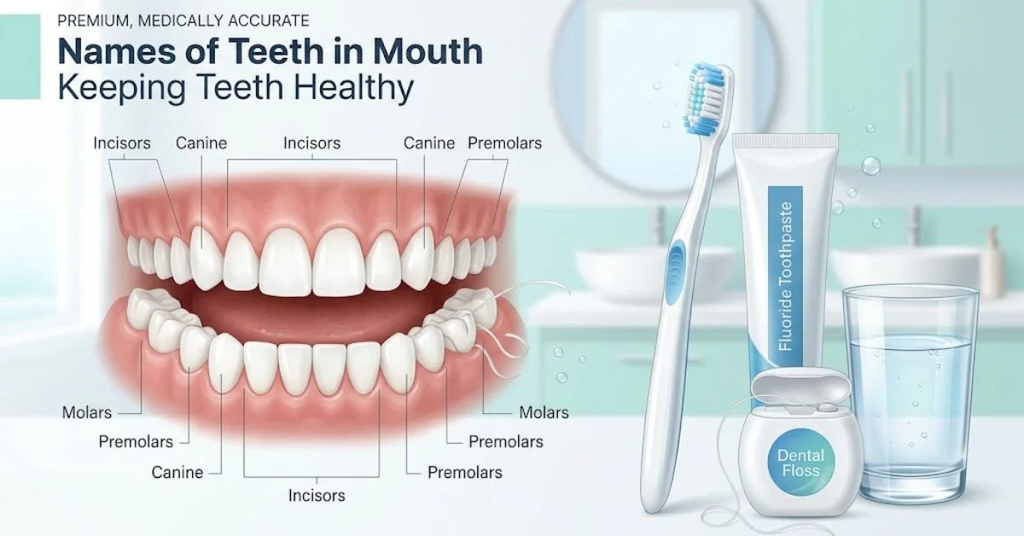
Every tooth type benefits from consistent oral hygiene. Brushing twice daily with fluoride toothpaste, cleaning between teeth, limiting frequent sugary foods and drinks, and receiving appropriate dental care are central habits for maintaining oral health.
Different teeth can present different practical challenges. Molars have broad grooves and sit farther back, while front teeth may be more exposed to trauma. Wisdom teeth can be particularly difficult to clean when their position or eruption is unusual. A dentist can tailor preventive advice to individual risk.
The best way to remember the names of teeth in mouth is to connect each name with its location and function incisors cut, canines tear, premolars crush, and molars grind. From there, central and lateral incisors, first and second premolars, and first through third molars become much easier to identify.
Understanding tooth names is more than memorizing vocabulary. It helps you understand a dental X-ray, follow a treatment conversation, describe where something hurts, and recognize the difference between a front tooth, premolar, molar, and wisdom tooth. If you have persistent pain, swelling, bleeding, a broken tooth, or prolonged sensitivity, the correct next step is a professional dental evaluation rather than self-diagnosis.
Conclusion
Understanding the names of teeth in mouth becomes much easier when you connect each tooth with its position and purpose. Incisors help cut food, canines grip and tear, premolars crush, and molars handle much of the grinding. From central and lateral incisors to first, second, and third molars, every tooth has a distinct place in the dental arch.
Knowing these teeth names, numbers, functions, and basic anatomy can also make dental charts, X-rays, and conversations with your dentist easier to understand. Whether you are learning about baby teeth, permanent teeth, wisdom teeth, or the Universal Numbering System, this simple framework gives you a clearer picture of how your mouth is organized. If you experience persistent tooth pain, swelling, sensitivity, or another unusual dental symptom, consult a qualified dental professional for personalized evaluation.
FAQs
What are the four main types of teeth?
The four main types of permanent human teeth are incisors, canines, premolars, and molars. Incisors primarily cut, canines help grip and tear, premolars crush, and molars perform much of the grinding during chewing.
How many teeth are in an adult mouth?
A complete permanent dentition can contain 32 teeth eight incisors, four canines, eight premolars, and 12 molars. The 12 molars include four third molars, or wisdom teeth. Some adults have fewer because wisdom teeth may never develop or may have been removed.
How many teeth do children have?
Children typically have 20 primary teeth eight incisors, four canines, and eight molars. Primary teeth do not contain premolars. The primary dentition is gradually replaced by permanent teeth during childhood.
What are the front teeth called?
The front teeth are primarily called incisors. They consist of central incisors and lateral incisors and are designed mainly for biting and cutting food. Their position also makes them important for speech and the appearance of the smile.
Which teeth are used for tearing food?
Canines are the pointed teeth most associated with tearing and gripping food. There are normally four permanent canines, with one located in each quadrant between the lateral incisor and first premolar.
What are premolars also called?
Premolars are commonly called bicuspids, although “premolar” is the preferred general dental term because premolar anatomy can vary and not every premolar has exactly two cusps. Permanent dentition normally contains eight premolars.
What are wisdom teeth?
Wisdom teeth are the third molars, located at the very back of the permanent dental arches. They may erupt normally, remain impacted, or be absent in some individuals. Whether they require treatment depends on their position, symptoms, and clinical findings.
Why do dentists use numbers as well as tooth names?
Numbers allow dentists to identify a specific tooth precisely in charts, X-rays, treatment plans, and records. In the United States, the Universal Numbering System identifies permanent teeth from 1 through 32, while primary teeth use letters.
What is the difference between premolars and molars?
Premolars sit between canines and molars and generally help crush and grind food. Molars are larger posterior teeth with broader chewing surfaces and are especially important for heavier grinding. Both contribute to breaking food into smaller pieces.
Are wisdom teeth considered molars?
Yes. Wisdom teeth are another name for third molars. They are the final molars in the permanent dentition and are located at the back of each quadrant when present.
What are the names of the upper teeth?
From the center toward the back, the permanent upper teeth are central incisor, lateral incisor, canine, first premolar, second premolar, first molar, second molar, and third molar. The same basic sequence occurs in the lower arch.
What are the names of the lower teeth?
The lower permanent teeth follow the same front-to-back naming sequence central incisor, lateral incisor, canine, first premolar, second premolar, first molar, second molar, and third molar. Their location is in the mandible, or lower jaw.
What are the parts of a tooth called?
The major tooth structures include the crown, root, enamel, dentin, pulp, and cementum. Supporting tissues also include the periodontal ligament and surrounding bone. Each component contributes to tooth strength, sensation, nourishment, or stability.

Liam Anderson is a passionate cat lover and the creator of OringeCatsNames. He enjoys sharing unique orange cat name ideas, pet tips, and helpful content to make life easier for cat owners around the world.