
Names of Teeth A Complete Guide to Their Types and Functions
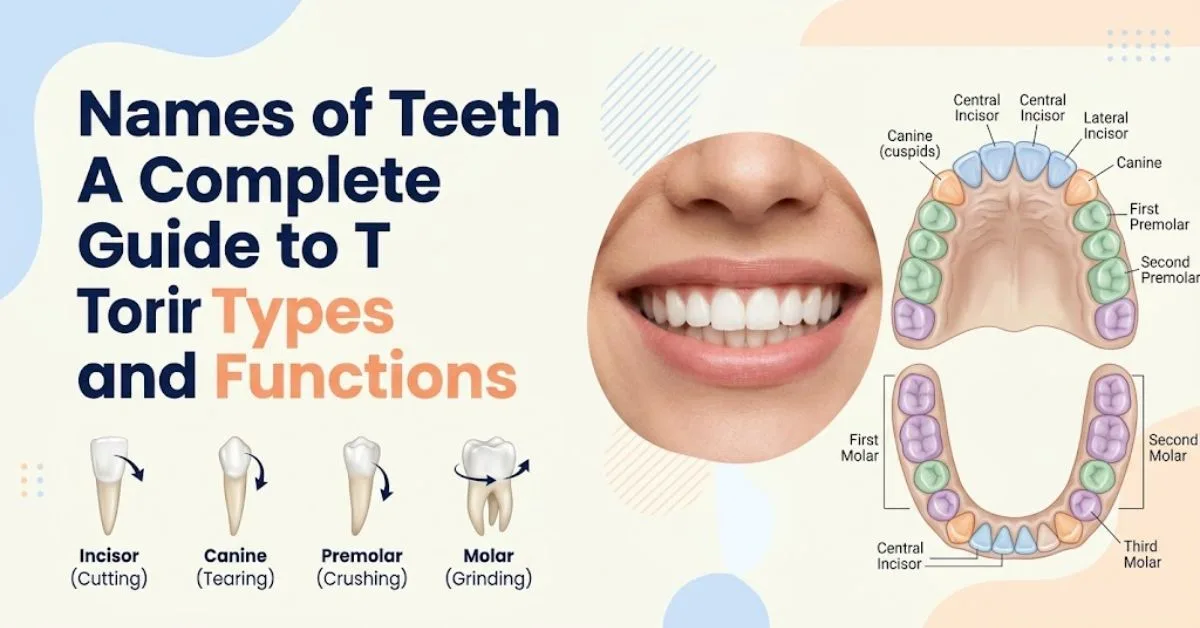
The names of teeth are incisors, canines, premolars, and molars, and each type helps you bite, tear, crush, or grind food. Most adults have 32 permanent teeth, including wisdom teeth, while children typically have 20 primary teeth. Knowing the names of teeth makes it easier to understand dental charts, identify individual teeth, and communicate with your dentist.
If you have ever wondered why your front teeth look different from the teeth at the back of your mouth, the answer lies in dental anatomy. Each tooth has a specialized shape and purpose. Understanding these differences, from the sharp edge of an incisor to the broad surface of a molar, can help you recognize your teeth, understand oral health advice, and feel more confident during dental appointments.
What are incisors?
Incisors are the eight front teeth in a typical adult mouth, with four in the upper jaw and four in the lower jaw. These teeth have narrow, chisel-shaped edges designed for cutting and biting food. When you bite into an apple or sandwich, your incisors do much of the initial work.
Healthline
+1
The four upper incisors and four lower incisors include central and lateral incisors. Central incisors sit closest to the middle of the mouth, while lateral incisors are immediately beside them. Their position also helps support the lips and contributes to clear speech and an attractive, natural smile.
What are canines?
Canines are the four pointed teeth positioned beside the lateral incisors. You have one canine in each quadrant of the mouth: upper right, upper left, lower right, and lower left. Also called cuspids or, informally, eye teeth, they have a pointed crown that helps tear food.
Cleveland Clinic
+1
Canines are particularly noticeable because their pointed shape differs from the flatter incisors. They help guide the upper and lower teeth as the jaws close and contribute to the appearance of the smile. Their long roots also help anchor them securely within the jawbone.
What are premolars?
Premolars, also called bicuspids, are located behind the canines and in front of the molars. A complete adult set contains eight premolars, with four in the upper jaw and four in the lower jaw. Their broad biting surfaces help crush and tear food during chewing.
Healthline
+1
Unlike primary teeth, premolars do not appear in the baby-teeth set. They develop as part of permanent dentition and replace the primary molars. Their shape combines some features of canines and molars, making them useful for handling food before it reaches the large grinding teeth at the back of the mouth.
What are molars?
Molars are the large teeth at the back of the mouth. In a complete adult dentition, there are 12 molars, including four wisdom teeth or third molars. Their broad crowns and multiple cusps provide the surface needed to crush and grind food into smaller pieces before swallowing.
Healthline
+1
The first molars generally erupt around age six, the second molars around age 12, and wisdom teeth often emerge in late adolescence or early adulthood. These are typical ranges, not fixed deadlines. Some people never develop wisdom teeth, while others have teeth that remain impacted beneath the gums.
What are the four types of teeth?
The four main types of human permanent teeth are incisors, canines, premolars, and molars. Their different shapes allow the teeth to work together during eating and speaking. Incisors cut, canines tear, premolars crush, and molars grind.
Cleveland Clinic
+1
The table below gives a quick reference to the names of teeth, their quantities in a complete adult set, and their primary functions.
| Type of tooth | Number in adults | Main function |
| Incisors | 8 | Biting and cutting |
| Canines | 4 | Tearing and guiding |
| Premolars | 8 | Crushing and tearing |
| Molars | 12 | Grinding and chewing |
| Total | 32 | Combined chewing and biting |
Counts describe a complete adult set including wisdom teeth. Actual tooth counts vary, particularly when wisdom teeth are absent or have been removed. Source: Cleveland Clinic and Healthline.
Cleveland Clinic
+1
These tooth types are arranged in the upper and lower dental arches. Each quadrant normally contains two incisors, one canine, two premolars, and three molars in a complete adult set. This arrangement helps distribute chewing forces across the mouth.
How do teeth function?
Teeth work together to break food into manageable pieces. Incisors cut into food, canines help tear it, premolars crush it, and molars grind it. The tongue moves food between the teeth, mixes it with saliva, and helps form a soft mass that can be swallowed.
Cleveland Clinic
+1
The process also supports digestion and speech. Teeth help shape certain sounds, support the lips and cheeks, and maintain the structure of the face. When a tooth is missing or damaged, chewing efficiency and speech may be affected, depending on its location and the extent of the problem.
What’s the anatomy of a tooth?
Every tooth has a crown and a root. The crown is the visible portion above the gumline, while the root extends into the jaw and anchors the tooth. The shape of the crown differs among incisors, canines, premolars, and molars because each type performs a different task.
Cleveland Clinic
+1
A tooth also contains several specialized tissues. Enamel protects the crown, dentin forms much of the underlying structure, cementum covers the root, and the pulp contains nerves, blood vessels, and connective tissue. The periodontal ligament connects the root to its socket, while the surrounding alveolar bone supports the teeth.
| Tooth part | Location | Function |
| Crown | Above the gumline | Visible biting or chewing surface |
| Root | Inside the jaw | Anchors the tooth |
| Enamel | Outer crown layer | Protects against wear and damage |
| Dentin | Beneath enamel and around pulp | Supports the tooth structure |
| Cementum | Covers the root | Helps attach the tooth to surrounding tissues |
| Pulp | Center of the tooth | Contains nerves and blood vessels |
Cleveland Clinic
+1
Understanding these parts can make dental explanations easier to follow. For example, a dentist may explain that a cavity has reached the dentin or that an infection involves the pulp. These terms describe different structures and can help clarify why a tooth may become sensitive or painful.
What are teeth numbers?
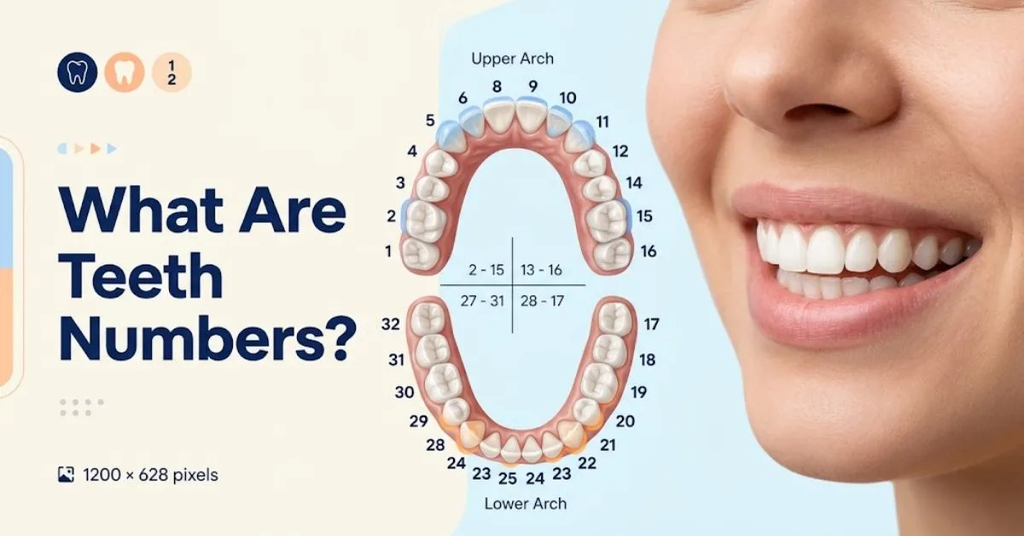
In the United States, dentists commonly use the Universal Numbering System to identify permanent teeth. The system assigns numbers from 1 through 32, beginning with the upper-right third molar, continuing across the upper arch, and then moving to the lower-left third molar and across the lower arch.
Cleveland Clinic
For primary teeth, the Universal system uses letters A through T. The sequence begins with the upper-right second molar, continues across the upper arch, then moves to the lower-left second molar and finishes at the lower-right second molar. These labels allow dentists to record examinations, treatment plans, and missing teeth accurately.
Universal Numbering System for adult teeth
Adult tooth numbers follow a specific sequence, not the order in which teeth erupt. Tooth #8 is the upper-right central incisor from the patient’s perspective, while #9 is the upper-left central incisor. The wisdom teeth are #1, #16, #17, and #32.
Cleveland Clinic
| Tooth number | Tooth name |
| #1 | Upper-right third molar |
| #8 | Upper-right central incisor |
| #9 | Upper-left central incisor |
| #16 | Upper-left third molar |
| #17 | Lower-left third molar |
| #24 | Lower-left central incisor |
| #25 | Lower-right central incisor |
| #32 | Lower-right third molar |
The patient’s right and left are used when identifying teeth, rather than the observer’s perspective. This distinction matters when reading dental charts or discussing a particular tooth with a dental professional.
Universal Numbering System for baby teeth
Baby teeth use letters rather than numbers in the U.S. Universal Numbering System. The upper-right second primary molar is labeled A, while the upper-left second primary molar is J. The sequence then continues through the lower-left and lower-right arches, ending at T.
Cleveland Clinic
A typical child has 20 primary teeth: eight incisors, four canines, and eight molars. There are no primary premolars. As children grow, primary molars are eventually replaced by permanent premolars, while permanent molars erupt farther back in the mouth.
How can I keep my teeth healthy?
Healthy teeth depend on daily oral hygiene and regular professional care. The American Dental Association recommends brushing twice a day with fluoride toothpaste and cleaning between teeth daily. Routine dental examinations help identify cavities, gum problems, and other concerns before they become more difficult to treat.
MouthHealthy
+1
A consistent routine can protect the enamel, support healthy gums, and help preserve the different types of teeth throughout life. Use a soft-bristled toothbrush, avoid brushing aggressively, and ask your dentist how often you should schedule cleanings based on your individual oral health needs.
- Brush twice daily with fluoride toothpaste.
- Clean between teeth daily with floss or an appropriate interdental cleaner.
- Limit frequent sugary snacks and drinks.
- Schedule regular dental examinations and cleanings.
- Seek professional advice for persistent tooth pain, swelling, or unusual sensitivity.
Dental advice should be personalized when a person has gum disease, extensive dental work, orthodontic appliances, or other oral-health concerns. A dentist can recommend suitable cleaning methods and treatment based on an examination.
The bottom line
The names of teethincisors, canines, premolars, and molarsdescribe four distinct types of teeth that work together to support biting, tearing, crushing, and grinding. A complete adult set contains 32 permanent teeth, while children typically have 20 primary teeth. Understanding their names, positions, functions, and numbering can make dental charts and conversations with your dentist much easier.
Knowing the difference between a canine and a molar is more than memorizing dental terminology. It helps you understand how your mouth works, recognize common dental explanations, and take an active role in protecting your smile. With regular brushing, daily cleaning between teeth, and professional dental care, you can help maintain healthy teeth and gums over time.
Names of Teeth in the Upper and Lower Jaw
Human teeth are arranged in two dental arches: the maxillary arch in the upper jaw and the mandibular arch in the lower jaw. Each arch contains teeth with different shapes and functions, allowing the mouth to cut, tear, crush, and grind food efficiently.
In a complete adult mouth, each half of the upper and lower jaw normally contains eight teeth: two incisors, one canine, two premolars, and three molars.
| Position | Upper jaw | Lower jaw |
| Front center | Central incisors | Central incisors |
| Beside central incisors | Lateral incisors | Lateral incisors |
| Next to lateral incisors | Canines | Canines |
| Behind canines | First and second premolars | First and second premolars |
| Back of mouth | First, second, and third molars | First, second, and third molars |
The third molars are commonly known as wisdom teeth. Not everyone develops all four, and some people have wisdom teeth that remain beneath the gums.
2. Names of Teeth in Children and Adults
Children and adults have different sets of teeth. Primary teeth are smaller and eventually fall out, while permanent teeth replace most primary teeth and generally remain throughout adulthood.
Primary teeth names
Children typically develop 20 primary teeth, beginning around six months of age. These include eight incisors, four canines, and eight molars. There are no premolars in the primary dentition.
| Primary tooth type | Number | Main role |
| Central incisors | 4 | Biting |
| Lateral incisors | 4 | Cutting |
| Canines | 4 | Tearing |
| First molars | 4 | Crushing |
| Second molars | 4 | Grinding |
| Total | 20 | Chewing and speech development |
Primary teeth help children chew food, develop speech, and maintain space for their permanent successors. Although baby teeth are temporary, cavities and infections in them still need appropriate dental attention.
Permanent teeth names
Most adults have 32 permanent teeth when all four wisdom teeth are present.
| Tooth group | Upper jaw | Lower jaw | Total |
| Incisors | 4 | 4 | 8 |
| Canines | 2 | 2 | 4 |
| Premolars | 4 | 4 | 8 |
| Molars | 6 | 6 | 12 |
| Total | 16 | 16 | 32 |
The permanent first molars typically erupt around age six, often before the front baby teeth have all fallen out. These are sometimes called six-year molars, and they do not replace primary teeth.
Dental Terms You Should Know
Understanding common dental terminology makes it easier to read treatment plans and discuss tooth names with a dentist.
| Dental term | Simple meaning |
| Dentition | The arrangement and development of teeth |
| Maxillary | Related to the upper jaw |
| Mandibular | Related to the lower jaw |
| Dental arch | Curved arrangement of teeth in a jaw |
| Cusp | Raised point on a tooth’s chewing surface |
| Gingiva | Medical term for gums |
| Occlusion | How upper and lower teeth meet |
| Eruption | Movement of a tooth into the mouth |
| Impacted tooth | A tooth that cannot fully erupt into its expected position |
| Edentulous | Having no natural teeth in a particular arch or the mouth |
These terms appear in dental records and oral-health education. For example, a dentist may describe a mandibular molar with an occlusal cavity, meaning a cavity on the chewing surface of a lower molar.
5. How Tooth Names Help You Understand Dental Visits

When a dentist identifies a tooth by name or number, they are communicating its exact location and type. This is important because the treatment for a damaged front incisor may differ from the treatment for a deeply decayed molar.
A dental chart may identify a tooth using a number, a surface abbreviation, or its anatomical name. These systems help dental professionals document examinations, fillings, crowns, root canal treatment, and extractions accurately.
For example, a note about a cavity in an upper-right first molar identifies both the location and the tooth group. Understanding this language can make it easier to ask questions about a recommended treatment.
If a dental chart or treatment plan is unclear, ask your dentist to point out the specific tooth and explain what the diagnosis means.
conclusion
The names of teeth help explain how the human mouth works, from the incisors at the front to the molars at the back. Each tooth has a specific shape, position, and function that supports chewing, speaking, and maintaining the structure of the face.
Understanding the four main types of teethincisors, canines, premolars, and molars also makes dental visits less confusing. Whether you are learning about baby teeth, permanent teeth, wisdom teeth, or the U.S. dental numbering system, knowing these terms helps you communicate more confidently with your dentist.
Remember that healthy teeth require consistent brushing, daily cleaning between teeth, and regular dental checkups. Taking care of every tooth, regardless of its name or location, is an important step toward maintaining a healthy smile for years to come.
FAQs
These questions reflect common informational needs associated with tooth names and dental anatomy. They are not claimed to be a verified live Google People Also Ask extraction.
What are the 4 names of teeth?
The four main types are incisors, canines, premolars, and molars. Incisors bite, canines tear, premolars crush, and molars grind food.
How many teeth do adults have?
Most adults have 32 permanent teeth, including four wisdom teeth. People who never develop wisdom teeth or have teeth removed may have fewer.
What are the names of the front teeth?
The front teeth are central incisors and lateral incisors. There are four upper and four lower incisors in a complete adult set.
What are the names of the back teeth?
The back teeth include premolars and molars. Premolars sit behind the canines, while molars are located at the very back of the mouth.
What are wisdom teeth called?
Wisdom teeth are called third molars. They are the last molars in each quadrant of the mouth and commonly emerge during late adolescence or early adulthood.
What are baby teeth called?
Baby teeth are called primary teeth, deciduous teeth, or milk teeth. A typical child has 20 primary teeth, which are gradually replaced by permanent teeth.
What is the difference between premolars and molars?
Premolars are smaller teeth located between canines and molars. They help crush and tear food, while the larger molars have broad surfaces designed mainly for grinding.
What are teeth numbered in the USA?
U.S. dentists commonly use the Universal Numbering System. Permanent teeth are numbered 1–32, while primary teeth are labeled A–T.

Liam Anderson is a passionate cat lover and the creator of OringeCatsNames. He enjoys sharing unique orange cat name ideas, pet tips, and helpful content to make life easier for cat owners around the world.